
Introduction
IT procurement has become one of the most operationally complex functions an SMB manages — and most organizations aren't staffed to handle it well. Hardware costs are climbing. Compliance requirements vary by state and industry. Supply chain delays that didn't exist three years ago now push lead times out by weeks.
Gartner forecasts worldwide IT spending will reach $6.31 trillion in 2026 — a 13.5% jump — yet only 55% of companies plan to increase their IT budgets this year, down from 62% in 2025. That gap signals a real shift: SMBs aren't looking to spend more, they're looking to spend smarter.
Outsourcing IT procurement to a specialized provider can reduce costs and shorten purchasing cycles — but only if you choose the right partner for your size, industry, and goals. The wrong fit adds overhead without solving the problems you actually have.
This list covers 10 providers worth evaluating in 2026, selected based on service depth, SMB relevance, and market track record.
Key Takeaways
- IT procurement services handle sourcing, purchasing, vendor management, and lifecycle management of technology assets on your behalf
- The best providers combine cost control, compliance support, and hardware/software expertise under one contract
- Options range from national IT resellers to AI-powered spend platforms, each suited to a different business size and budget
- Prioritize response time guarantees, cybersecurity alignment, TCO transparency, and contract flexibility when evaluating
- nDataStor leads this list for SMBs in Northern California seeking procurement bundled with managed IT, 24/7 cybersecurity, and a dedicated vCIO
What Is IT Procurement and Why It Matters in 2026
IT procurement is the structured process of sourcing, purchasing, managing, and retiring technology assets — hardware, software, cloud subscriptions, and services — in a way that controls costs, meets compliance requirements, and supports business goals.
The Cost of Getting It Wrong
Unmanaged procurement creates real financial exposure. Shadow IT alone accounts for 30%–40% of IT spending in most organizations, and the average business wastes $135,000 annually on unnecessary SaaS tools — often because no structured procurement process exists to track what's been purchased.
Compliance adds another layer. 20 U.S. states now enforce comprehensive consumer data privacy laws, and CMMC 2.0 requirements for defense contractors alongside tightening HIPAA risk assessment rules mean regulated SMBs face real exposure when procurement decisions skip security and compliance vetting.
AI Is Reshaping Procurement Workflows
A 2025 survey of 210 U.S. procurement executives found 40% already use AI for decision-making, with 73% past the experimentation phase. The AI-in-procurement market is growing at a 28.1% CAGR.
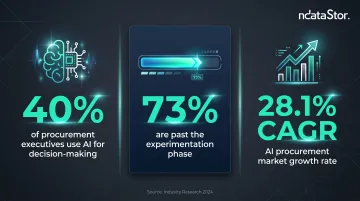
Providers with embedded AI capabilities — covering license optimization, spend visibility, and compliance documentation — deliver efficiency gains that manual processes simply can't replicate at scale.
Given these pressures, choosing the right procurement partner matters more than ever. The providers below cover the full range of options available in 2026 — from national IT resellers and managed service providers to enterprise spend platforms built for regulated industries.
Top 10 IT Procurement Service Providers to Consider in 2026
Providers were evaluated on service breadth, SMB and mid-market relevance, cybersecurity integration, vendor relationships, contract flexibility, and customer trust signals.
1. nDataStor
Founded in 2008 and headquartered in Fairfield, California, nDataStor is a managed IT and cybersecurity firm that offers IT procurement as part of a comprehensive technology partnership for SMBs across Northern California. Services span hardware sourcing, software licensing, vendor management, cloud procurement, and lifecycle planning.
What distinguishes nDataStor from a standard IT reseller is its vCIO model. Every client receives a dedicated Virtual Chief Information Officer who aligns procurement decisions with business strategy, preventing overspending and keeping every buying decision tied to long-term goals. Recommendations are vendor-neutral: clients get the right technology, not the most profitable one.
The firm also integrates AI-powered threat prevention across its managed services model and actively supports HIPAA, CMMC, and PCI-DSS compliance for clients in healthcare providers, law firms, and financial sectors. Recognized as Best IT Services in Fairfield 2025.
| Category | Details |
|---|---|
| Best For | SMBs and regulated businesses in Northern California seeking procurement bundled with managed IT and 24/7 cybersecurity |
| Key Services | Hardware/software sourcing, vendor management, IT lifecycle planning, cloud solutions, vCIO advisory, compliance support |
| Pricing | Custom pricing; 100% money-back guarantee; bundled managed services available |

2. CDW
CDW is the largest publicly traded IT solutions provider in the U.S., reporting $22.42 billion in FY2025 net sales — a 6.8% year-over-year increase. That scale translates directly to vendor access: CDW maintains partnerships with thousands of technology brands and offers eProcurement integration with ERP platforms, custom catalogs, and dedicated account management.
CDW's size can mean less personalized service for sub-100-employee SMBs, but for mid-size companies with defined purchasing needs, the buying power and vendor-neutral catalog are hard to match. Broad product selection, fast fulfillment, and structured procurement support are where it consistently delivers.
| Category | Details |
|---|---|
| Best For | Mid-size to large businesses needing broad product selection with fast fulfillment |
| Key Services | Hardware/software procurement, configuration services, cloud purchasing, managed services, financing |
| Pricing | Volume-based pricing; dedicated account rep model; financing available |
3. SHI International
SHI International is the largest privately held IT solutions provider in the world, surpassing $16 billion in rolling 12-month gross sales as of October 2025. It's also the largest minority- and woman-owned business enterprise (MWBE) in the U.S.
SHI's primary differentiation is software asset management (SAM). Its licensing advisory, renewals optimization, and long-tail vendor management capabilities help organizations reduce licensing waste and negotiate enterprise agreements more effectively than most internal teams can manage alone. Organizations managing tangled multi-vendor software contracts get a single point of contact backed by genuine licensing expertise.
| Category | Details |
|---|---|
| Best For | Organizations with complex software licensing needs and multi-vendor environments |
| Key Services | Software licensing, SAM, hardware procurement, cloud marketplace, IT lifecycle management |
| Pricing | Contract-based; licensing optimization fees; enterprise agreement negotiation |
4. Insight Direct
Insight Enterprises operates across 19 countries with over 30 years of technology procurement experience, reporting $8.7 billion in FY2024 net sales. Its myInsight Procurement Platform provides catalog searching, order tracking, quote management, and reporting tools in a single interface.
Insight differentiates through its Connected Workforce and cloud transformation expertise, with strong vendor certifications across Microsoft, Cisco, and Dell. It recently achieved Microsoft verified MXDR (Managed Extended Detection and Response) solution status , a credential that matters specifically for businesses managing security alongside procurement decisions.
| Category | Details |
|---|---|
| Best For | Mid-market businesses undergoing cloud migration or workforce modernization alongside procurement |
| Key Services | Hardware/software sourcing, cloud procurement, lifecycle management, deployment services, managed services |
| Pricing | Project-based and managed services models; pricing varies by scope |
5. Connection (PC Connection)
Connection has served SMBs and mid-market companies since 1982 and operates three dedicated divisions: Business Solutions (SMB), Enterprise Solutions, and Public Sector Solutions. With 5,000+ technical certifications across staff and connections to more than 150 strategic VAR partners, Connection brings legitimate depth to both product procurement and technical support.
It earned the 2025 CRN Triple Crown Award — combining Solution Provider 500, Tech Elite 250, and Fast Growth 150 recognition — and has been named by Newsweek as one of America's Most Trustworthy Companies. Q1 2026 results showed 17.5% year-over-year sales growth.
| Category | Details |
|---|---|
| Best For | SMBs and mid-market companies seeking straightforward IT procurement with responsive account support |
| Key Services | Hardware/software procurement, networking, cloud solutions, professional services, lifecycle support |
| Pricing | Competitive retail and contract pricing; account-based model |
6. Presidio
Presidio combines hardware/software procurement with deep expertise in cloud, networking, security, and data center infrastructure. Its security-first procurement model ensures every technology asset is vetted for compliance and integration fit before purchase, a structural advantage for organizations in regulated industries.
The company operates a co-managed services model with 24/7/365 infrastructure support and has expanded into European markets via its acquisition of Ergo. Its appearance alongside Deloitte at AWS re:Invent 2025 for agentic AI and procurement discovery points to an active push toward AI-driven procurement automation.
| Category | Details |
|---|---|
| Best For | Mid-market and enterprise clients in regulated industries needing security-integrated procurement |
| Key Services | IT procurement, cloud infrastructure, managed security, networking, data center solutions |
| Pricing | Managed services contracts; project-based engagements; pricing by scope |
7. ePlus Technology
ePlus reported $2.07 billion in FY2025 net sales and earned the 2025 CRN Triple Crown Award alongside Connection. Its OneSource IT platform centralizes technology acquisition and management across complex hybrid environments, and its 200+ contract vehicles for government and education procurement make it a strong fit for SLED buyers.
The company's vendor-agnostic approach means ePlus designs, procures, and manages IT environments based on architecture fit rather than preferred vendor margins. Its focus areas — AI, security, cloud, data center, and networking — cover the full scope of modern IT procurement needs.
| Category | Details |
|---|---|
| Best For | Organizations building hybrid cloud environments who need procurement combined with architecture advisory |
| Key Services | IT procurement, hybrid cloud, security, managed services, financing, lifecycle management |
| Pricing | Flexible financing and managed services; project and subscription models |

8. Zones
Zones brings an e-commerce-first approach to IT procurement, with its ZonesConnect portal providing pre-approved SKU catalogs, dollar-amount-based purchase authorization, custom approval workflows, and real-time pricing and availability data. The myZones platform adds IT order and inventory management with custom reporting.
Zones delivers speed and simplicity for SMBs with lean IT teams that want a self-service procurement experience without enterprise-level overhead. It earned a spot on CRN's 2024 Solution Provider 500 list and has been a consistent presence in the SMB procurement space since 1986.
| Category | Details |
|---|---|
| Best For | SMBs and growing companies that want easy, self-service IT procurement with solid vendor selection |
| Key Services | Hardware/software procurement, cloud services, peripherals, IT asset management, reporting tools |
| Pricing | Competitive catalog pricing; portal-based ordering; account-based pricing available |
9. GEP
GEP is an AI-native procurement platform and consulting firm, operating as both a software provider (GEP SMART) and a managed procurement services organization. Its GEP MINERVA AI powers spend analytics, strategic sourcing, contract management, and supplier risk management across a single source-to-pay platform.
GEP earned Leader status in the 2025 and 2026 Gartner Magic Quadrants for Source-to-Pay Suites and was ranked #1 in Source-to-Contract and Source-to-Pay by The Hackett Group. It primarily serves Fortune 500 and Global 2000 companies, so it's best suited for mid-to-large organizations investing in full procurement transformation, not businesses with simpler purchasing needs.
| Category | Details |
|---|---|
| Best For | Mid-to-large enterprises looking to automate and optimize procurement with AI-powered tools |
| Key Services | Spend analytics, strategic sourcing, contract management, supplier risk management, procurement BPO |
| Pricing | SaaS subscription + managed services; enterprise pricing; see GEP website for details |
10. Coupa Software
Coupa is a cloud-based Business Spend Management (BSM) platform taken private by Thoma Bravo for approximately $8 billion in 2023. It was named a Leader in the 2026 Gartner Magic Quadrant for Source-to-Pay Suites for the third consecutive year, with the highest placement in Ability to Execute.
Coupa's AI capabilities are trained on $7 trillion in proprietary spend data across 10 million+ buyers and suppliers, a dataset that grows by $1.3 trillion annually. Its Contract Intelligence feature can analyze thousands of supplier contracts for specific risks in under a day. Coupa is purpose-built for mid-market and enterprise buyers; SMBs with straightforward purchasing needs will likely find it more platform than they require.
| Category | Details |
|---|---|
| Best For | Mid-market and enterprise businesses seeking unified procurement and spend visibility |
| Key Services | Procure-to-pay, sourcing, contract management, supplier management, spend analytics, invoicing |
| Pricing | SaaS subscription; pricing based on modules and user count; contact Coupa for quotes |
How We Chose the Best IT Procurement Service Providers
Evaluation Criteria
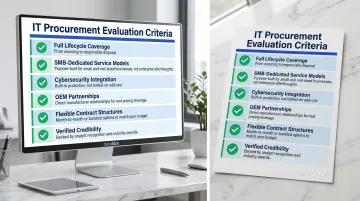
Providers were selected based on:
- Covers the full procurement lifecycle, from sourcing and vendor selection through asset disposal
- Offers dedicated service models for smaller organizations, not just enterprise-tier clients
- Embeds cybersecurity review into procurement workflows rather than adding it as an afterthought
- Brings real OEM partnerships and purchasing leverage that translate to better pricing and availability
- Provides flexible contract structures — month-to-month options, managed services bundles, or multi-year agreements
- Demonstrates credibility through analyst recognition, industry awards, and verifiable client outcomes
Common Mistakes to Avoid
Choosing an IT procurement partner based on brand name alone is the most expensive mistake SMBs make. These mistakes come up repeatedly:
- Focusing on unit price without accounting for implementation, maintenance, and replacement costs skews the true cost of ownership
- Skipping security vetting during sourcing creates compliance exposure — especially in healthcare, legal, and financial services, as well as manufacturing businesses with operational technology environments
- Overlooking SLA response times treats slow support as a minor inconvenience, when hardware failures and licensing emergencies are business continuity issues
- Selecting enterprise platforms like GEP or Coupa for a 50-person company — their implementation complexity and cost routinely exceed what smaller organizations actually need
Match the provider to your actual operational scope. A standalone procurement vendor suits some businesses fine; others need it integrated with managed IT, security, and strategic advisory services from day one.
Conclusion
The best IT procurement partner in 2026 isn't necessarily the one with the largest catalog or the biggest revenue figure. It's the one that aligns with your compliance requirements, operational goals, and growth plans — and can execute without requiring you to manage them.
Before signing any contract, evaluate providers against these criteria:
- Response time guarantees (and what they cover)
- Cybersecurity integration in the sourcing process
- TCO transparency, not just unit pricing
- Lifecycle management capabilities from acquisition to disposal
- Industry-specific expertise relevant to your regulatory environment
If those criteria matter to your business, the provider you choose should meet all of them without requiring separate vendors for each piece.
For SMBs across Northern California, nDataStor bundles procurement with managed IT, 24/7 cybersecurity monitoring, compliance support, and a dedicated vCIO — backed by a 30-minute response guarantee and a 100% money-back guarantee. Schedule a free consultation to find out what the right procurement partnership looks like for your business.
Frequently Asked Questions
What does an IT procurement service do?
IT procurement involves sourcing, purchasing, and managing technology assets — hardware, software, and cloud services — on behalf of an organization. A managed procurement service handles vendor selection, pricing negotiation, compliance vetting, and lifecycle tracking so your internal team doesn't have to.
What are the 7 stages of procurement?
The standard procurement cycle has seven stages:
- Need identification
- Purchase requisition
- Vendor evaluation and selection
- Purchase order issuance
- Order fulfillment and receipt
- Invoice processing and payment
- Record maintenance and lifecycle management
What are the 4 types of procurement?
The four types are: direct procurement (materials used in production), indirect procurement (operational supplies and IT), services procurement (outsourced labor and professional services), and capital procurement (major assets and infrastructure investments).
What does hardware procurement mean?
Hardware procurement refers to sourcing and purchasing physical IT equipment — servers, laptops, networking gear, and storage — including vendor selection, pricing negotiation, order management, and deployment coordination.
How do I find vendors for IT procurement?
Options include working with a managed IT provider like nDataStor (which brings established vendor relationships), using procurement platforms such as Coupa or SAP Ariba, or issuing RFPs directly. Evaluate vendors on pricing, certifications, compliance history, and support reliability.
What's the best platform for end-to-end procurement?
Enterprise platforms like SAP Ariba, Coupa, and GEP SMART suit large organizations with complex workflows. SMBs typically get better value from a managed IT provider that bundles procurement into a broader technology partnership, sidestepping the heavy implementation overhead these platforms require.