
The math is straightforward: you can't secure what you can't see, and you can't optimize spending on assets you haven't tracked.
This guide breaks down what IT Asset Management (ITAM) actually means in 2026, why the stakes are higher than ever for hybrid environments, and which solutions are worth evaluating — whether you're running a 50-person healthcare practice or a 500-seat technology firm.
Key Takeaways
- ITAM tracks, manages, and optimizes hardware, software, and cloud assets across their full lifecycle — from procurement through disposal.
- Untracked assets drive security incidents, compliance failures, and wasted SaaS spend — costs that routinely run into the tens of millions for mid-size and larger organizations.
- AI-powered discovery has made real-time asset visibility accessible at every budget level, not just enterprise.
- Top solutions covered: ServiceNow ITAM (enterprise), ManageEngine AssetExplorer (SMB), Lansweeper (agentless discovery), SysAid (unified ITSM+ITAM), and Virima (mid-market hybrid IT).
- SMBs without in-house IT staff can partner with a managed services provider to implement and run ITAM on their behalf.
What Is IT Asset Management and Why Does It Matter in 2026?
The Core Definition
IT Asset Management is the end-to-end process of tracking, managing, and optimizing every IT asset an organization owns — hardware (laptops, servers, network switches), software (licensed applications, operating systems), and cloud/virtual assets (SaaS subscriptions, virtual machines) — from the moment of purchase through final disposal.
ITAM isn't just an inventory spreadsheet. It's a decision-making framework built on accurate, real-time asset data.
The IT asset lifecycle runs through five stages:
- Plan: Identify what's needed and set budgets before purchasing
- Procure: Acquire assets through approved vendors with documented specs
- Deploy: Configure, license, and assign assets to users or systems
- Maintain: Apply patches, monitor performance, and manage throughout active use
- Retire/Dispose: Decommission securely, wipe data, and close out records
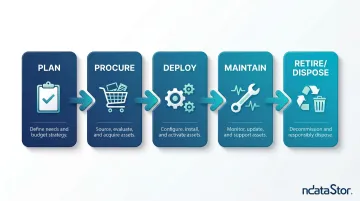
Skipping any stage creates gaps. The most expensive gap? Missing retirement tracking — which leaves "zombie assets" on the network that carry both security risk and ongoing licensing costs long after they serve any purpose.
Why 2026 Specifically
ITAM has become more urgent in 2026 than at any prior point, driven by three converging pressures.
Gartner projects 90% of organizations will operate hybrid cloud environments through 2027 — meaning assets now span on-premises infrastructure, multiple cloud platforms, and remote employee devices simultaneously. Manual audits can't keep up with that distribution.
SaaS spending has compounded the problem. The Flexera 2025 State of ITAM Report found complete technology stack visibility dropped to 43% (down from 47% year-over-year), with 35% of respondents reporting SaaS waste is increasing. Meanwhile, 45% of organizations spent over $1 million on software audits in the past three years alone.
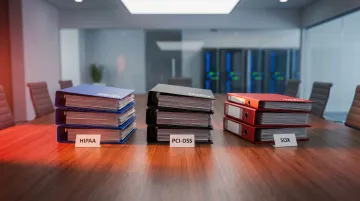
Compliance pressure has added a third layer. HIPAA's Security Rule requires accurate inventories of all systems handling ePHI. PCI-DSS Requirement 2.4 explicitly mandates a component inventory. SOX Section 404 ties financial reporting integrity to IT system accuracy. Unmanaged assets aren't just a security problem — they're an audit liability that law firms and other regulated businesses increasingly face scrutiny over.
Four Business Outcomes ITAM Delivers
- Eliminate unused licenses and redundant hardware before renewals hit
- Close security gaps — every untracked device is a potential entry point
- Maintain audit-ready asset records on demand, not scrambled together post-notice
- Provision employees with the right tools at the right time, reducing downtime delays
Top IT Asset Management Solutions & Vendors in 2026
These five vendors were evaluated across: discovery capability, lifecycle management depth, ITSM integration quality, compliance reporting, and total cost of ownership — including implementation complexity and ongoing admin burden. The list spans enterprise to SMB, so you can match tool to environment rather than defaulting to brand name.
Quick Reference: All Five Vendors
| Vendor | Best For | Starting Price |
|---|---|---|
| ServiceNow ITAM | Large enterprises on existing ServiceNow deployments | Custom enterprise quote |
| ManageEngine AssetExplorer | SMB to mid-market teams on a budget | $955/year (250 assets) |
| Lansweeper | Teams needing rapid agentless discovery | $199/month (2,000 assets) |
| SysAid | Mid-sized teams wanting ITSM + ITAM in one platform | Custom quote |
| Virima | Mid-market to enterprise hybrid IT environments | $10,000/year (SMB bundle) |
ServiceNow ITAM
ServiceNow ITAM is an integrated module within the broader ServiceNow platform — widely considered the enterprise standard for connecting asset lifecycle management with IT service operations. It covers hardware and software asset tracking, discovery, license management, and AI-assisted automation through Now Assist (available on Professional Plus and Enterprise Plus tiers).
Its defining strength is native integration: asset data flows directly into incident, change, and problem management workflows without manual syncing. Discovery and normalization capabilities reduce duplicate records, and the platform's partner ecosystem supports complex global implementations. ServiceNow was named the only Leader in the 2025 Gartner Magic Quadrant for AI Applications in IT Service Management.
The tradeoffs are significant. Implementation is complex, total cost of ownership is high, and the platform requires dedicated admin resources to realize its value. It's the right choice for organizations already on ServiceNow — not for teams starting from scratch.
| Category | Details |
|---|---|
| Key Features | Integrated hardware/software lifecycle management, AI-powered automation (Now Assist), discovery and normalization, audit-ready compliance reporting |
| Best For | Large enterprises with mature ITSM practices and existing ServiceNow deployments |
| 2026 Pricing | Custom enterprise quote; subscription-based on asset/installation count; separate ITAM and ITOM module fees apply on top of base licensing |
ManageEngine AssetExplorer
ManageEngine AssetExplorer is a dedicated ITAM tool from Zoho's enterprise IT division, built specifically for SMB and mid-market teams watching their budgets. It covers asset discovery, software license tracking, purchase order management, and lifecycle monitoring — and it integrates natively with ManageEngine's broader ecosystem (ServiceDesk Plus, OpManager).
The free tier supports up to 25 nodes permanently, making evaluation zero-risk. For teams already running ManageEngine's help desk, AssetExplorer adds ITAM depth without introducing a new vendor relationship.
| Category | Details |
|---|---|
| Key Features | Agent + agentless discovery, software license compliance alerts, purchase order and vendor management, mobile asset auditing (barcode/QR/RFID), native ManageEngine ecosystem integration |
| Best For | SMB to mid-market teams (especially those already in the ManageEngine ecosystem) needing affordable, fast-to-deploy ITAM |
| 2026 Pricing | Free tier: 25 nodes (permanent). On-premises: from $955/year for 250 assets. Cloud: from $1,245/year for 250 assets. |
Lansweeper
Lansweeper is a Cyber Asset Intelligence platform built around agentless network discovery. It scans IP ranges, Active Directory, and cloud environments to surface hardware, software, and connected devices — no agents required on every endpoint. Gartner Peer Insights lists Lansweeper under the Cyber Asset Attack Surface Management category, reflecting its evolution beyond traditional ITAM.
Agentless scanning is its signature capability: immediate, broad visibility without heavy deployment overhead. It covers hardware, software, patch status, and license compliance in a single tool. One limitation: native ITSM workflow integration relies on API connectors rather than built-in modules, and advanced reporting may require SQL scripting.
| Category | Details |
|---|---|
| Key Features | Agentless discovery across IP ranges, AD, and cloud; centralized hardware/software inventory; license compliance alerts; missing patch detection; SQL-based custom reporting |
| Best For | Mid-to-large IT teams needing rapid agentless discovery; SMBs wanting asset visibility without agent deployment overhead |
| 2026 Pricing | Starter: $199/month (2,000 assets, billed annually). Pro: $379/month (up to 9,000 assets). Enterprise: custom. 14-day full trial available. |
SysAid
SysAid combines help desk, asset management, patch management, and workflow automation in a single platform — which suits mid-sized IT teams that want ITSM and ITAM under one roof without managing two separate tools. Its partnership with Lansweeper enables deeper scanning as an add-on, creating a modular path from basic asset discovery to comprehensive cyber asset intelligence.
AI is embedded at all three pricing tiers: ticket routing, asset classification, emotion analysis, and nearly 100 prebuilt AI agents. Setup is notably straightforward for an ITSM+ITAM platform. The tradeoff is customization depth — complex enterprise configurations push against the platform's limits, and Lansweeper's deeper scanning requires a separate Pro plan license.
| Category | Details |
|---|---|
| Key Features | Unified help desk and asset management, built-in network discovery, Lansweeper integration for deeper scanning, patch management, remote control, AI-powered ticket routing and asset classification |
| Best For | Mid-sized IT teams wanting consolidated ITSM + ITAM without assembling a multi-vendor stack |
| 2026 Pricing | Custom quote across three tiers: Standard (Help Desk), Pro (ITSM), Enterprise — contact for pricing |
Virima
Virima is a mid-market ITAM and CMDB platform combining automated discovery, a dynamic configuration management database, visual service mapping (ViVID), and full lifecycle asset management in one subscription. It integrates bi-directionally with ServiceNow, Jira Service Management, Ivanti, HaloITSM, and others.
The standout capability is ViVID: it overlays ITSM incidents and National Vulnerability Database (NVD) data directly onto live maps of how assets connect to business services. Seeing a vulnerability's blast radius in the context of actual service dependencies is a feature typically reserved for enterprise-tier platforms.
Autonomic Social Discovery (ASD) fills in attributes that automated scanners miss — including asset ownership, business criticality, and SLAs — using adaptive learning to route intelligence gathering to the right people.
| Category | Details |
|---|---|
| Key Features | Agent + agentless discovery (AWS, Azure, on-prem), ViVID visual service mapping with NVD vulnerability overlays, bi-directional ITSM integration, CMDB, software license optimization, Autonomic Social Discovery |
| Best For | Mid-market to enterprise organizations managing hybrid IT who need unified discovery, CMDB, and ITAM without enterprise-level pricing |
| 2026 Pricing | SMB bundle: $10,000/year (up to 100 servers + 900 devices). Enterprise: custom quote. Pricing is asset-count based with no hidden fees. |
How We Chose These ITAM Solutions
The Evaluation Framework
Each vendor was assessed against five criteria:
- Discovery depth — coverage across on-premises, cloud, and remote environments
- Lifecycle management completeness — procurement through secure disposal
- ITSM integration quality — bi-directional sync vs. one-way data pushes
- Compliance and security reporting — audit readiness, vulnerability integration
- Total cost of ownership — licensing, implementation effort, and ongoing admin burden
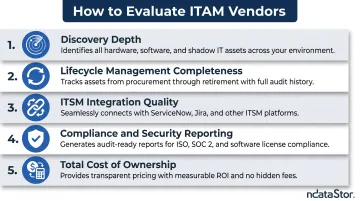
The most common mistake buyers make is evaluating tools on feature lists alone. A platform with 200 capabilities that requires a full-time admin to maintain is not the right fit for a 10-person IT team, even if the features look compelling on paper.
Why This Specific List
The selection was intentional about range:
- Enterprise scale: ServiceNow, for organizations already in that ecosystem
- SMB-accessible: ManageEngine (lowest absolute entry price), Lansweeper (best per-asset value at SMB scale)
- Consolidated ITSM+ITAM: SysAid, for teams that want fewer tools
- Mid-market hybrid IT: Virima, for organizations that outgrew basic scanning but aren't ready for ServiceNow pricing
Where nDataStor Fits In
For SMBs and growing businesses across Northern California without a dedicated IT team, ITAM tool selection doesn't have to be a solo exercise. nDataStor's managed IT services include IT Asset & Lifecycle Management as part of its broader managed IT engagement, so clients work directly with an experienced team rather than figuring out deployment alone.
That engagement covers:
- Proactive endpoint monitoring
- Hardware lifecycle management
- Compliance support for HIPAA, PCI-DSS, and CMMC
- vCIO-level planning to align your asset strategy with business goals
Conclusion
ITAM isn't optional in 2026. Untracked assets are a live cybersecurity liability — every unused license, forgotten endpoint, or unretired device represents both financial waste and exposure you can avoid.
Before committing to any platform, assess three things:
- Does the tool's discovery capability cover your actual environment — on-premises, cloud, and remote endpoints?
- What does total cost of ownership look like over three years, not just year one license fees?
- Do you have internal capacity to implement and maintain it, or do you need a partner to run it?
Many SMBs can't confidently answer all three without outside support — and that's where the right managed IT partner makes the difference. If you're a business in Northern California looking to get your IT assets under control without building an internal IT department, nDataStor's managed IT services include proactive asset monitoring, cybersecurity protection, and a dedicated virtual CIO who helps you build and execute the right ITAM strategy from day one. Reach out for a no-obligation consultation.
Frequently Asked Questions
What does IT asset management do?
ITAM tracks, manages, and optimizes all IT hardware, software, and cloud assets throughout their full lifecycle — from procurement and deployment through maintenance and disposal. It gives organizations clear visibility into what they own, what it costs, and whether each asset is in use, secure, and compliant.
What are the trends in software asset management for 2025 and 2026?
Leading trends include AI-powered license discovery, SAM-cybersecurity platform integration, and SaaS spend optimization. The Flexera 2025 State of ITAM Report found managing software use rights jumped to the #1 SAM concern (up from #6 the prior year) — a direct reflection of rising audit risk and AI-driven software costs.
What are the 5 P's of asset management?
The 5 P's are Plan, Procure, Provide, Protect, and Purge — covering the full asset lifecycle from identifying needs and acquiring hardware to deploying, securing, and responsibly retiring assets. Interpretations vary, but the framework maps directly to standard ITAM practice.
What is the difference between ITAM and ITSM?
ITAM focuses on tracking and optimizing IT assets throughout their lifecycle. ITSM (IT Service Management) focuses on delivering and managing IT services to users. The two are closely linked: ITSM depends on accurate ITAM data to resolve incidents quickly, execute changes safely, and keep services running. Tools like SysAid and ServiceNow combine both in a single platform.
How does IT asset management improve cybersecurity?
ITAM ensures every device and application is visible, patched, and accounted for — untracked endpoints are among the most common ransomware entry points. Beyond discovery, ITAM helps enforce software policies, flags unauthorized installations, and ensures decommissioned devices are securely wiped before leaving the organization's control.
What ITAM solution is best for small businesses?
ManageEngine AssetExplorer (starting at $955/year with a free 25-node tier) and SysAid (combined ITSM and ITAM with AI built in) are the strongest SMB options. The right choice depends on your existing tools, environment complexity, and whether you have internal IT staff managing it — or a managed services provider like nDataStor handling implementation and ongoing management on your behalf.