
Introduction
PCI DSS v4.0 Requirement 11.4 isn't optional language buried in a compliance checklist — it mandates structured penetration testing for every organization that stores, processes, or transmits cardholder data. Miss it, and you're looking at compliance violations, potential fines, and a security posture that looks solid on paper but collapses under real attack conditions.
The problem most businesses run into isn't finding a penetration testing firm. There are thousands of them. The problem is finding one that actually understands PCI DSS's specific requirements: correct scoping of the cardholder data environment, segmentation validation, and a final report formatted the way your QSA expects to see it.
Hire a generalist pen tester to satisfy a PCI-specific requirement, and you may spend thousands of dollars on a report that your auditor won't accept — then start over. According to the IBM Cost of a Data Breach Report 2024, the average global breach cost hit $4.88 million, with financial industry breaches among the costliest. This guide profiles the top PCI DSS-focused penetration testing providers for 2026 — and explains what separates firms that deliver audit-ready results from those that don't.
Key Takeaways
- PCI DSS v4.0 Requirement 11.4 mandates internal and external pen testing at least annually and after significant infrastructure changes
- Not every pen testing firm understands PCI DSS scoping, segmentation testing, or audit-ready report formats — confirm these capabilities before you hire
- Top providers: Coalfire, A-LIGN, Trustwave, Prescient Security, and SecurityMetrics
- Key selection criteria: QSA credentials or partnerships, segmentation testing capability, remediation retesting, and auditor-accepted report formats
What PCI DSS Penetration Testing Actually Requires
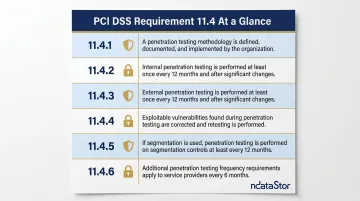
PCI DSS v4.0 Requirement 11.4 is more specific than most organizations realize. It defines a structured set of obligations with distinct sub-requirements, each with its own scope and timing.
The Six Sub-Requirements Under 11.4
| Sub-Requirement | What It Requires |
|---|---|
| 11.4.1 | Define, document, and implement a pen testing methodology; retain results for 12 months |
| 11.4.2 | Internal penetration test assessing the CDE from inside the network |
| 11.4.3 | External penetration test assessing the CDE from outside the network perimeter |
| 11.4.4 | Remediate all exploitable vulnerabilities found; conduct retesting to confirm resolution |
| 11.4.5 | Segmentation testing to verify out-of-scope systems cannot reach the CDE |
| 11.4.6 | Multi-tenant service providers must support customer pen testing requirements |
Testing must use an industry-accepted methodology (OWASP, NIST SP 800-115, or PTES are commonly cited), and the tester must be organizationally independent from the systems under test.
Vulnerability Scanning vs. Penetration Testing
Understanding this distinction matters because the two requirements sit under different sub-sections — and auditors treat them separately.
- Vulnerability scanning (Requirement 11.3): Automated, identifies known weaknesses without exploitation; external scans must be performed quarterly by an approved scanning vendor (ASV)
- Penetration testing (Requirement 11.4): Manual, involves a live tester actively exploiting vulnerabilities to determine depth of potential compromise
Segmentation Testing — The Requirement Many Firms Miss
Requirement 11.4.5 mandates testing that confirms your CDE is genuinely isolated from out-of-scope systems. Merchants must test segmentation at least annually; service providers must do it every six months. Many generalist pen testing firms skip this step entirely, leaving a compliance gap your QSA will flag during the formal assessment.
Top Penetration Testing Companies for PCI DSS Compliance in 2026
The providers below were selected based on PCI DSS-specific credentials, methodology depth, audit-ready reporting, and demonstrated experience in payment security environments. Use this list by matching your organization's size and compliance needs to each provider's strengths — the tables under each entry summarize fit at a glance. If you're managing PCI DSS alongside other frameworks like SOC 2 or HIPAA, several entries below handle multi-framework engagements in a single assessment. Healthcare providers and law firms managing cardholder data often face exactly this multi-framework challenge.
Coalfire
Coalfire is one of the largest PCI Qualified Security Assessor Companies (QSACs) globally, delivering over 1,000 PCI DSS assessments annually with 15+ years in the payment compliance space. They're a founding member of the PCI Global Executive Assessor Roundtable and one of only five PCI Forensic Investigators (PFIs) covering the US and Europe.
What makes Coalfire distinct for pen testing is how tightly their testing and assessment practices are integrated. Testers and QSAs operate from a unified compliance framework, meaning findings map directly to PCI DSS controls and feed straight into the Report on Compliance (RoC).
Their Compliance Essentials platform spans 75+ compliance frameworks and consolidates evidence collection across the audit cycle — reducing the scramble that typically precedes audit close.
| Category | Details |
|---|---|
| Best Suited For | Large enterprises, payment processors, and cloud service providers requiring full RoC-level documentation |
| Key Credentials | QSAC, PCI Forensic Investigator (PFI), Qualified PIN Assessor (QPA), founding PCI Roundtable member |
| PCI-Specific Capability | Integrated QSA + pen testing workflow; segmentation testing and remediation guidance included |
A-LIGN
With 4,000+ penetration tests completed across 5,700+ global clients and a 96% client satisfaction rating, A-LIGN operates as both a PCI Qualified Security Assessor and a penetration testing provider. That dual role makes them a practical choice for organizations wanting a single vendor to cover their annual PCI audit and required testing in one engagement.
Their testers hold OSCP, OSCE, and OSEE certifications — the hands-on OffSec credentials that carry real weight in a compliance context. Reports are formatted to satisfy PCI DSS auditor requirements, with findings mapped to specific requirements and retesting available within the same audit window.
| Category | Details |
|---|---|
| Best Suited For | Mid-market businesses seeking a combined PCI QSA and pen testing partner |
| Key Credentials | PCI QSA; SOC 2, ISO 27001, HITRUST, FedRAMP audit capabilities |
| PCI-Specific Capability | Auditor-formatted findings reports; retesting within the audit window |
Trustwave
Trustwave brings some of the deepest PCI DSS operational history of any firm on this list — SpiderLabs has been building and refining payment security methodologies since 2009, across retail point-of-sale environments, e-commerce platforms, and payment gateways.
They hold four CREST accreditations: Vulnerability Assessment, Penetration Testing, STAR, and STAR-FS intelligence-led penetration testing. They've been named a Top 10 MSSP by MSSP Alert for eight consecutive years. Their threat intelligence-informed approach means test scenarios reflect current attack patterns, not just static checklists.
| Category | Details |
|---|---|
| Best Suited For | Retailers, e-commerce businesses, and payment service providers needing integrated PCI compliance and threat intelligence |
| Key Credentials | CREST-accredited (four designations); 8x MSSP Alert Top 10; recognized by Gartner |
| PCI-Specific Capability | PCI-aligned pen testing plus ASV scanning; threat intelligence integrated into test scenarios |

Prescient Security
Prescient Security is a CREST-accredited penetration testing provider and licensed CPA firm — a pairing that works well for organizations managing PCI DSS alongside other audit obligations like SOC 2 or HIPAA. Their testing practice covers 25+ compliance frameworks, and they can run multi-framework assessments within a single engagement.
Their PTaaS platform, Cacilian, is the differentiator here. It provides real-time visibility into testing progress, compliance workflow tracking, and integration with platforms like Vanta — so PCI DSS evidence and remediation status get documented as testing proceeds, rather than assembled in a scramble before the audit closes.
| Category | Details |
|---|---|
| Best Suited For | Organizations managing PCI DSS alongside SOC 2, HIPAA, or ISO 27001 |
| Key Credentials | CREST-accredited; licensed CPA firm; CSA STAR certified |
| PCI-Specific Capability | Real-time compliance workflow tracking via Cacilian; multi-framework testing in a single engagement |
SecurityMetrics
SecurityMetrics is the most explicitly SMB-focused provider on this list, and it shows in how their services are packaged. They hold both QSA and ASV status, have served 300,000+ organizations, and have been in the compliance space for 25+ years. For a small business handling payment data for the first time, that combination of guided support and practical pricing matters.
Their FastPass technology automates portions of the SAQ process (which can contain up to 267 questions depending on business type), and they automatically report compliance status directly to your acquiring bank once validation is complete. Penetration testing is bundled with compliance packages rather than quoted as a separate enterprise engagement.
| Category | Details |
|---|---|
| Best Suited For | Small and mid-sized merchants, e-commerce businesses, and first-time PCI DSS compliance seekers |
| Key Credentials | PCI QSA, ASV certified; 300,000+ organizations served; 25+ years of experience |
| PCI-Specific Capability | SAQ guidance bundled with pen testing; compliance reporting formatted for acquiring banks and QSAs |
How to Choose the Right PCI DSS Pen Testing Partner
Price is the wrong starting point. A penetration test that produces a report your QSA won't accept isn't a cost-effective choice at any price.
The Evaluation Framework
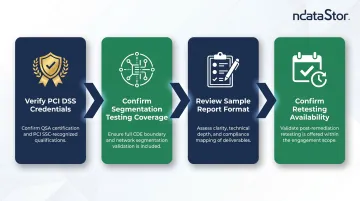
When comparing providers, prioritize these four factors:
- Verify PCI DSS-specific credentials: QSA status, active QSA partnerships, or ASV certification — not just general security certs
- Confirm their methodology explicitly covers segmentation validation (Requirement 11.4.5), or budget for a separate engagement
- Request a sample report; it should map findings directly to PCI DSS requirements and be formatted for auditor review
- Confirm they can retest within the same audit window — discovering a report gap two weeks before closure is an expensive problem to solve
Additional Factors Worth Weighing
- Tester certifications: OSCP, CREST, CEH, and GPEN are recognized in PCI contexts; the PCI SSC doesn't mandate specific credentials but requires demonstrated experience
- Cloud environment experience: If your CDE includes AWS, Azure, or GCP components, verify the firm has tested hybrid architectures
- Rescoping after changes: Confirm the firm has a transparent process for retesting after significant infrastructure changes, which PCI DSS also requires
For SMBs in Northern California
For smaller businesses, choosing a provider that bundles remediation guidance with the initial test matters more than brand recognition. A findings report that doesn't satisfy your QSA days before audit closure is avoidable with the right partner from the start.
That's where a local managed IT partner like nDataStor fits in. For Northern California businesses, nDataStor helps coordinate the scoping, documentation, and remediation cycle — preparing your environment for PCI DSS, HIPAA, or CMMC requirements before you bring in a specialized tester.
Conclusion
PCI DSS penetration testing isn't interchangeable with a general security assessment. The right provider needs to understand the specific scoping rules in Requirement 11.4, the segmentation testing obligations in 11.4.5, and the report formats that QSAs actually accept. Technical skill gets you through the test. PCI DSS domain knowledge is what makes the results usable for compliance.
For businesses in Northern California managing PCI DSS obligations alongside broader IT security needs, nDataStor provides compliance support and managed security services — helping you identify gaps, harden your environment, and coordinate effectively with specialized pen testing providers before your QSA engagement. Reach out to nDataStor to discuss where your environment stands ahead of your next audit cycle.
Frequently Asked Questions
Does PCI DSS require penetration testing?
Yes. PCI DSS v4.0 Requirement 11.4 explicitly mandates penetration testing at least annually and after any significant infrastructure or application changes. Testing must use an industry-accepted methodology and be performed by a qualified, organizationally independent resource — internal or external.
What happens after vulnerabilities are found during a PCI DSS pen test?
PCI DSS Requirement 11.4.4 requires organizations to remediate all exploitable vulnerabilities found during testing, then retest to confirm resolution. Remediation evidence must be documented and available for QSA review before the assessment closes.
How often is PCI DSS penetration testing required?
At minimum, annually for both internal and external testing. Additional testing is required after significant changes — major infrastructure upgrades, new cardholder data flows, topology changes, or cloud migrations all qualify as triggers under the standard.
What is the difference between internal and external PCI DSS penetration testing?
External testing targets systems accessible from outside the network perimeter; internal testing simulates a threat actor already inside it. Requirements 11.4.2 and 11.4.3 mandate both, with the cardholder data environment in scope for each.
Which certification is most relevant for PCI DSS pen testers?
OSCP (Offensive Security Certified Professional) is widely regarded as the most credible hands-on credential for penetration testers. At the firm level, CREST accreditation signals rigorous technical vetting that QSAs and enterprise clients recognize. CEH and CompTIA PenTest+ are also commonly cited, though the standard evaluates demonstrated competence over credentials alone.