
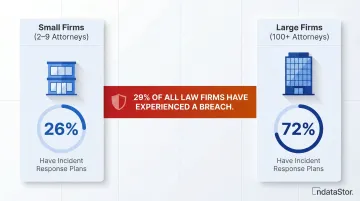
According to the ABA's 2023 Legal Technology Survey, 29% of law firms reported experiencing some form of security breach — and small firms are now prominently represented in publicly filed breach notifications. Yet only 26% of firms with 2–9 attorneys have a documented incident response plan.
Choosing the wrong cybersecurity provider — or skipping the decision entirely — exposes your firm to ABA compliance violations, state breach notification penalties, and reputational damage that clients don't forgive. This guide cuts through the noise with a vetted 2026 shortlist built specifically for small law firm realities.
Key Takeaways
- Small law firms hold high-value data but rarely have dedicated security staff — making them disproportionate targets
- ABA Model Rule 1.6(c) legally requires "reasonable efforts" to protect client data; all 50 states carry breach notification obligations
- The best providers combine legal-industry knowledge, 24/7 monitoring, and compliance support — not generic IT helpdesk
- Key selection factors: response time guarantees, ransomware readiness, legal software compatibility, and transparent pricing
- nDataStor serves Northern California law firms with dedicated Legal IT Specialists, a 30-minute response guarantee, and a 100% money-back guarantee
Why Small Law Firms Are Prime Cybersecurity Targets in 2026
The Low-Defenses, High-Value Data Problem
Law firms of any size manage M&A details, litigation strategies, medical and health-related client records, and financial records that cybercriminals can monetize through extortion, resale, or competitive intelligence. Small firms carry the same data risk as large ones — just with far fewer resources protecting it.
That gap shows up clearly in the numbers. While 29% of all law firms report experiencing a breach, only 26% of firms with 2–9 attorneys have incident response plans, compared to 72% at 100+ attorney firms. Attackers know this. Small firms are increasingly named in public breach filings precisely because the path of least resistance runs through them.
The Threats Targeting Legal Staff Right Now
The ABA's 2025 reporting on AI-powered phishing documents a sharp escalation in attack sophistication targeting lawyers and staff — voice spoofing, brand look-alike payment portals, and urgent wire transfer scams that exploit the time pressure attorneys operate under daily.
The primary threat vectors small firms face today:
- Phishing and spear-phishing — the leading initial access method, now amplified by AI-generated content
- Ransomware — over 26% of ransomware attacks in 2024 targeted law firms; many victims paid over $100,000 to restore access
- Human error — accidental data disclosure, weak passwords, and misdirected emails remain top breach causes
- Unpatched software — practice management and document platforms with delayed updates create exploitable gaps
- Unsecured remote access — VPNs and remote desktop tools configured without multi-factor authentication are common entry points
Each of these vectors requires a dedicated defense layer. A qualified cybersecurity provider should show you exactly how they address each one, not hand you a generic firewall and antivirus bundle and call it coverage.
Best Cybersecurity Providers for Small Law Firms in 2026
These providers were selected for legal-industry knowledge, security depth, responsiveness, and suitability for firms without in-house IT staff.
nDataStor
nDataStor is a Northern California–based managed IT and cybersecurity firm founded in 2008 and recognized as Best IT Services in Fairfield 2025. Originally a financial-industry hardware specialist, the company has evolved into a full-service IT security partner serving small and mid-sized businesses — including law firms — across Solano, Yolo, Sacramento, and Santa Clara Counties.
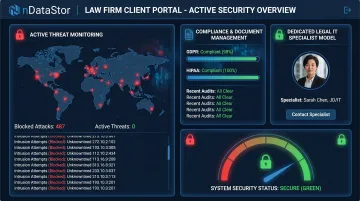
What makes nDataStor stand out for small law firms is its dual-assignment model: every law firm client receives a dedicated Legal IT Specialist and vCIO from day one. That specialist helps firms build secure environments covering case management systems, document automation, and compliant data storage — understanding the legal stack, not just the IT stack.
The security stack covers the core bases small law firms need:
- AI-powered threat prevention with 24/7 monitoring and rapid incident response
- Remote and on-site support across Northern California — useful when a matter-blocking incident can't be resolved remotely
- 100% money-back guarantee (cancel anytime, full refund), removing the adoption risk that makes budget-conscious firms hesitant to commit
| Detail | Information |
|---|---|
| Best For | Small and mid-sized law firms in Northern California needing a local, full-service cybersecurity and managed IT partner |
| Key Security Features | AI-powered threat prevention, 24/7 monitoring, ransomware defense, compliance support, remote and on-site support |
| Pricing Model | Managed services model; contact for custom quote. Backed by a 100% money-back guarantee and 30-minute response SLA. |
Frontline Managed Services
Frontline serves only law firms — no other industries. That exclusivity translates into a service desk staff trained on the legal software stack: time-and-billing platforms, conflicts systems, document management, and practice management tools. When a matter-blocking issue comes in, it doesn't get triaged as a generic IT ticket.
The scale is substantial: Frontline supports 250,000+ legal users and 300+ legal software platforms, with 24/7/365 follow-the-sun coverage. For a small firm without IT staff, that depth of coverage can substitute for an internal help desk entirely.
| Detail | Information |
|---|---|
| Best For | Small firms that want a law-firm-only provider with high-volume, always-on help desk coverage |
| Key Security Features | Managed cybersecurity, endpoint protection, identity management, compliance-aligned security governance |
| Pricing Model | Subscription-based managed IT plans; verify current pricing directly with provider |
Arctic Wolf
Arctic Wolf delivers 24/7 SOC-as-a-service through a managed detection and response (MDR) model, monitoring both network and cloud environments using an open XDR architecture. For a small firm without internal security analysts, it effectively places an enterprise-grade security operations center behind their systems around the clock.
Arctic Wolf was named a Leader in the 2024 IDC MarketScape for Worldwide MDR Services and is included in the Gartner Market Guide for MDR Services. Its staff security awareness training is particularly relevant for law firms, where human error is among the most common breach entry points.
| Detail | Information |
|---|---|
| Best For | Small firms seeking enterprise-grade 24/7 SOC monitoring without hiring a full security team |
| Key Security Features | Managed detection and response (MDR), vulnerability assessments, cloud and network monitoring, compliance support, security awareness training |
| Pricing Model | Per-user/per-month subscription model; contact for current quote |
Adlumin
Adlumin's differentiator is User and Entity Behavior Analytics (UEBA) — detecting anomalous behavior across endpoints and cloud environments rather than relying solely on signature-based threat detection. For law firms, where a compromised employee credential or insider threat can cause significant damage before triggering obvious alerts, behavioral detection provides a meaningful additional layer.
Its one-touch compliance reporting is a practical advantage for legal teams. Law firms facing ABA reasonable-efforts audits, cyber insurance questionnaires, or state regulatory inquiries can generate documentation directly from the platform — without manually compiling security logs or burdening non-technical staff.
| Detail | Information |
|---|---|
| Best For | Firms prioritizing behavioral threat detection, compliance reporting automation, and dark web exposure monitoring |
| Key Security Features | UEBA, managed SOC with ML-enabled technology, dark net monitoring, one-touch compliance reporting |
| Pricing Model | Platform + managed service subscription; contact for pricing details |
Eden Data
Eden Data is a cybersecurity consultancy founded in 2021 (Austin, TX) with a team of former military cyber professionals and Big 4 consultants. Its subscription tiers — Seed, Sprout, and Sapling — replace unpredictable hourly billing with flat monthly rates, making professional-grade security accessible to solo practitioners and small practices managing tight budgets.
The consultancy model suits firms that need a compliance program built from the ground up rather than just monitoring layered on top. Eden Data assesses the client environment and recommends only what's needed — a meaningful distinction for smaller firms that don't want to be oversold tools they can't operationalize.
| Detail | Information |
|---|---|
| Best For | Budget-conscious small firms or solo practitioners seeking flexible, subscription-based cybersecurity consulting |
| Key Security Features | Security and compliance consulting, data privacy, vulnerability assessments, bespoke law firm security solutions |
| Pricing Model | Tiered subscription plans (Seed, Sprout, Sapling); no long-term contracts required |
How We Selected These Providers
Evaluation Criteria
Providers on this list were assessed against criteria tied directly to small law firm operations:
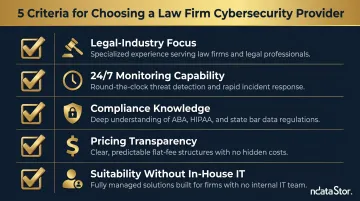
- Legal-industry focus — not just a law firm landing page, but demonstrated expertise in legal workflows, compliance obligations, and legal software environments
- Documented 24/7 monitoring or response capability — small firms can't afford gaps in coverage
- Compliance knowledge — familiarity with ABA Model Rule 1.6(c), ABA Formal Opinion 477R, state breach notification laws, and HIPAA where applicable
- Pricing transparency — clear service tiers or at least a defined model, not opaque quotes
- Suitability for firms without in-house IT — the provider should function as the firm's security team, not supplement one
A Common and Costly Mistake
Many small firms select a generalist IT vendor based on price, then discover that vendor has no familiarity with legal software workflows, doesn't understand attorney-client privilege obligations, and has no documented procedure for handling a ransomware attack affecting active case files. That gap typically surfaces mid-incident — when active case files are locked and client communications are down.
Before You Sign Anything
This list is a starting shortlist, not a comprehensive directory. Before committing to any provider:
- Request a written SLA — specifically what response time covers and what remediation steps are guaranteed
- Ask how they handle a matter-blocking security incident — get a specific, documented answer
- Verify backup and restore procedures are tested — documented recovery is not the same as tested recovery
- Confirm compliance knowledge is current — ABA guidance and state laws evolve; your provider should track them
Conclusion
Cybersecurity for a small law firm is a professional obligation — tied directly to client confidentiality, ABA compliance, and the firm's ability to keep operating after an attack. Breach remediation, client notification, regulatory penalties, and reputational damage reliably cost more than a managed security partnership. The math favors acting now.
Prioritize providers with legal-specific expertise, clear SLAs with defined response times, and transparent pricing over simply choosing the largest name on the market.
Firms in Northern California can request a free IT Security and Performance Assessment from nDataStor — a local provider specializing in legal IT with automated threat detection and a 100% money-back guarantee. The assessment covers your current gaps and produces a security plan built around your practice's specific needs.
Frequently Asked Questions
Do law firms need cybersecurity?
Yes — law firms are legally and ethically required to protect client data under ABA Model Rule 1.6(c), and all 50 U.S. states have data breach notification laws with penalties. Small firms are frequently targeted because attackers assume weaker defenses relative to the value of the data held.
What is the best cybersecurity for a small law firm?
The strongest approach combines managed detection and response (MDR) or a 24/7 SOC service with endpoint protection, email security, and compliance support. Choose a provider with specific legal-industry experience — a generic small business IT vendor unfamiliar with legal workflows will leave gaps.
How much does cybersecurity typically cost for a small law firm?
Costs vary by service scope and model. Managed security subscriptions can range from a few hundred to several thousand dollars per month depending on firm size. Flat-fee or subscription arrangements are more budget-predictable than hourly or break-fix pricing.
What compliance standards do small law firms need to meet?
At minimum: ABA Model Rule 1.6(c) on reasonable data safeguards, applicable state breach notification laws, and HIPAA if the firm handles health-related matters — similar to the compliance obligations healthcare providers manage for covered entities. A qualified provider should document your compliance efforts and map controls to each obligation.
What is the biggest cybersecurity threat to small law firms today?
Phishing and ransomware are the leading threats, with human error as the primary entry point. AI-generated spear-phishing has made attacks far more convincing in 2025–2026, making staff training and email security non-negotiable layers of defense.
Can a small law firm manage cybersecurity in-house?
Most small firms lack the staffing and expertise to manage 24/7 monitoring, patch management, incident response, and compliance documentation internally. Outsourcing to a managed security provider is more cost-effective and more robust than a self-managed approach for firms without dedicated security staff.