
Introduction
Healthcare organizations have ranked as the most expensive industry for data breaches for 14 consecutive years. The 2025 IBM/Ponemon Cost of a Data Breach report puts the average healthcare breach at $7.42 million — nearly double the global cross-industry average of $4.44 million. Meanwhile, patient records sell for up to $1,000 each on the dark web, roughly 200 times the value of a stolen credit card number.
That threat environment makes security validation far more than a compliance formality. HIPAA's Security Rule (§ 164.308(a)(8)) requires covered entities and business associates to conduct periodic technical evaluations, and penetration testing has become the most widely accepted method for satisfying that requirement.
The problem: not every penetration testing vendor is equipped to operate safely inside a healthcare environment, or to produce the audit-ready documentation that OCR expects.
This guide covers the top penetration testing companies for healthcare HIPAA compliance in 2026, the criteria used to evaluate them, and the key questions to ask before signing an engagement.
Key Takeaways
- HIPAA § 164.308(a)(8) requires periodic technical evaluations — penetration testing is the most accepted method to satisfy this, per NIST SP 800-66 Rev. 2
- Healthcare vendors must know EHRs, legacy systems, medical devices, and clinical workflows — generic security firms often miss these gaps
- The best vendors produce HIPAA-mapped, OCR-defensible reports — not generic findings PDFs
- Top providers for 2026: Cybri, NetSPI, Drummond Group, Red Sentry, and Software Secured
- After testing, a managed IT partner ensures findings get remediated and documented — not just flagged
Why Healthcare Requires Specialized Penetration Testing
A Uniquely Complex Attack Surface
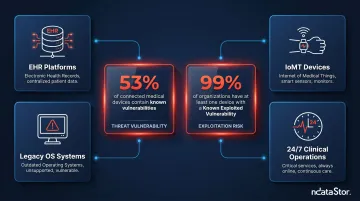
Healthcare IT environments don't resemble a typical corporate network. They combine:
- EHR platforms with third-party API integrations across labs, pharmacies, and insurers
- IoMT devices — from infusion pumps to imaging systems — often running software that cannot be patched or taken offline during a test
- Legacy operating systems on medical equipment (73% of healthcare providers still run legacy OS on medical devices, per Kaspersky's research)
- 24/7 operational requirements where downtime is a patient safety issue, not just an operational inconvenience
Claroty's 2025 State of CPS Security report, which analyzed over 2.25 million IoMT devices across 351 organizations, found that 53% of connected medical devices contain known vulnerabilities, and 99% of organizations had at least one device with a Known Exploited Vulnerability. A general-purpose pen tester walking into that environment without healthcare-specific protocols is a liability, not an asset.
The Compliance Layer General Vendors Miss
HIPAA, HITECH, and HITRUST don't just require testing — they require documentation that maps findings to specific regulatory safeguards. OCR audits are looking for evidence of due diligence, not just a report that says "we found 12 vulnerabilities."
The HITRUST CSF harmonizes 70+ frameworks — including HIPAA, NIST, and ISO — into a single assessment methodology. Vendors familiar with this framework map pen test findings directly to control domains, producing documentation that supports both HITRUST certification and OCR scrutiny.
HHS OCR settled four HIPAA ransomware investigations in April 2026 alone (its 12th through 15th enforcement actions in its Risk Analysis Initiative), each citing failures to conduct thorough risk analyses. Organizations without defensible technical evaluation records face growing regulatory exposure.
The Ransomware Reality
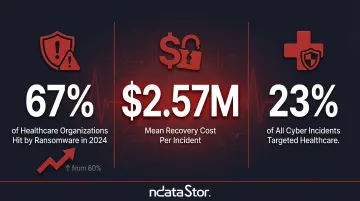
67% of healthcare organizations were hit by ransomware in 2024, up from 60% the year prior, with mean recovery costs reaching $2.57 million per incident. Healthcare accounted for 23% of all cyber incidents in 2024 — more than any other industry.
The vendors below were selected because they understand this environment and can test it without disrupting care delivery.
Best Penetration Testing Companies for Healthcare HIPAA Compliance 2026
These companies were evaluated across five criteria:
- Healthcare-specific experience and clinical environment familiarity
- HIPAA compliance alignment in methodology and reporting
- Methodology rigor (manual testing depth, not just automated scans)
- Report quality and audit-readiness
- Ability to test clinical systems without disrupting operations
Cybri
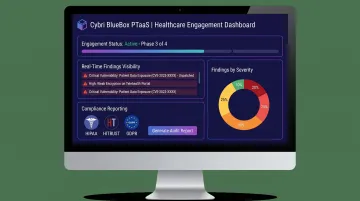
Cybri is a US-based penetration testing firm with a dedicated healthcare practice, offering manual red team assessments across web applications, APIs, networks, EHR systems, and medical devices through its proprietary BlueBox PTaaS platform.
For healthcare clients, Cybri brings US-based certified testers, real-time engagement visibility via BlueBox, and HIPAA and HITRUST CSF compliance mapping built into every report. Complimentary retesting is included — when an auditor asks whether findings were addressed, you have documented proof rather than a verbal assurance.
| Category | Details |
|---|---|
| Best For | Healthcare organizations seeking collaborative, HIPAA-specific manual pentesting with real-time engagement visibility |
| Key HIPAA-Related Services | EHR and medical device testing, HIPAA Security Rule–mapped reporting, HITRUST CSF alignment, complimentary retesting |
| Engagement Model | Project-based and PTaaS via BlueBox; US-based testers; custom scoping per engagement |
NetSPI
NetSPI operates at enterprise scale with an extensive in-house team of penetration testers, offering continuous security validation for large health systems, hospital networks, and healthcare technology companies.
NetSPI's Resolve platform surfaces findings as they're confirmed, so remediation can start before the engagement closes. Executive dashboards support compliance reporting, and integrations with SIEM and ticketing tools feed findings directly into existing workflows. Coverage extends to cloud, mainframe, IoT, and AI/ML systems, making it a strong fit for complex, multi-site healthcare enterprises.
| Category | Details |
|---|---|
| Best For | Large healthcare enterprises and health systems needing continuous, auditable penetration testing at scale |
| Key HIPAA-Related Services | Real-time findings via Resolve platform, cloud and IoT testing, HIPAA/SOC 2 compliance deliverables, SIEM integrations |
| Engagement Model | PTaaS subscription with custom enterprise pricing; real-time remediation management |
Drummond Group
Drummond Group is a healthcare-focused cybersecurity firm with deep compliance alignment for HIPAA, HITECH, and HITRUST-regulated environments.
Its assessments produce documentation structured to support regulatory reviews — materials that hold up during formal OCR audits or HITRUST certification processes, not generic findings exports. Services include IoMT and medical device testing, social engineering, and cloud security assessments, covering a typical health system's full attack surface.
| Category | Details |
|---|---|
| Best For | Healthcare organizations prioritizing audit-ready HIPAA and HITRUST compliance documentation |
| Key HIPAA-Related Services | IoMT/medical device testing, cloud pen testing, social engineering, HITRUST CSF alignment |
| Engagement Model | Project-based with compliance-framework-driven scoping; best suited for mid-to-large health organizations |
Red Sentry
Red Sentry delivers threat-focused penetration testing for healthcare environments, combining automated scanning with manual attack techniques to assess EHRs, patient portals, medical devices, and vendor integrations — with faster turnaround than most traditional firms.
For healthcare teams that need timely results ahead of audits or after system changes, Red Sentry's ability to produce detailed, actionable reports in days (not weeks) is a practical advantage. Its testers have familiarity with clinical workflows and business logic vulnerabilities specific to healthcare applications.
| Category | Details |
|---|---|
| Best For | Healthcare providers and digital health companies needing fast, threat-focused pentesting without long lead times |
| Key HIPAA-Related Services | EHR, patient portal, and IoT testing; HIPAA compliance documentation; business logic and social engineering assessments |
| Engagement Model | Project-based with rapid reporting timelines; hybrid automated and manual methodology |
Software Secured
Software Secured specializes in manual penetration testing for healthcare SaaS companies and technology vendors handling PHI, mapping all findings to OWASP Top 10, SANS Top 25, and NIST to support HIPAA compliance at the application layer.
Transparent pricing, a zero-false-positives commitment, and ongoing remediation coaching via Slack make it a strong fit for smaller healthcare organizations and health tech startups. PTaaS options are available alongside standalone engagements for teams that need continuous coverage without enterprise overhead.
| Category | Details |
|---|---|
| Best For | Healthcare SaaS vendors and smaller healthcare providers needing manual app and API testing with remediation support |
| Key HIPAA-Related Services | Web, mobile, API, and network testing; HIPAA-mapped vulnerability reports; PTaaS option; transparent pricing |
| Engagement Model | Project-based or PTaaS; Slack-based remediation coaching; pricing disclosed upfront |
How We Chose the Best Healthcare Penetration Testing Companies
Evaluation Criteria
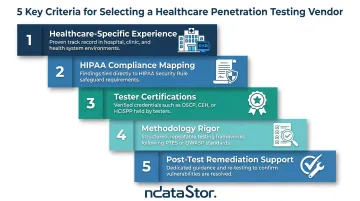
Every vendor on this list was assessed against five criteria:
- Healthcare-specific experience — direct work with EHRs, IoMT devices, and clinical environments, not just regulated industries in general
- HIPAA compliance mapping — findings tied explicitly to Security Rule safeguards, not generic vulnerability categories
- Tester certifications — OSCP, CISSP, HITRUST Assessor, or equivalent credentials; not just automated tool operators
- Methodology rigor — manual exploitation as the core method, not scan-and-report
- Post-test remediation support — retesting, coaching, or tracking to confirm fixes were implemented
A common mistake: selecting vendors based on price or brand name without confirming whether their testers have actually worked inside regulated healthcare environments. Generic cybersecurity firms can run a competent network scan — but producing documentation that satisfies an OCR auditor requires specific knowledge of how HIPAA maps to technical controls.
Safety-First Scoping
The best vendors treat clinical uptime as a hard constraint. Look for firms that:
- Schedule testing around operational windows to avoid peak care hours
- Avoid active production systems — particularly EHR integrations and medical devices
- Use controlled techniques scoped specifically for patient-facing environments
In a 24/7 clinical setting, a misconfigured test against a medical device isn't just a technical failure. It's a patient safety risk.
The Role of an Ongoing Security Partner
A penetration test produces a findings report. What happens next determines whether the investment actually reduces risk.
For small and mid-sized healthcare organizations in Northern California — as well as law firms and other regulated businesses managing sensitive records — coordinating pen test findings with ongoing monitoring, patch management, and remediation tracking is where many programs fall short.
nDataStor, a managed IT and cybersecurity provider serving healthcare organizations across Solano, Yolo, and Sacramento Counties, offers 24/7 monitoring, HIPAA compliance support, and proactive security management to bridge the gap between a point-in-time pen test and a continuous security posture. The objective is confirmed closure of vulnerabilities, not just a report.
Conclusion
Choosing a penetration testing partner in healthcare is a strategic decision that directly affects patient data security, operational continuity, and your ability to withstand OCR scrutiny. The right vendor brings technical depth, healthcare domain knowledge, and the ability to translate findings into a defensible compliance posture.
Before signing any engagement, verify the vendor meets your baseline requirements:
- Ask for sample reports from prior healthcare engagements
- Confirm tester certifications and hands-on healthcare experience
- Clarify what post-test remediation support looks like
- Verify that findings map directly to HIPAA Security Rule safeguards
The documentation a vendor produces either holds up in a regulatory review or it doesn't. Confirm that before you sign.
Healthcare providers and health-adjacent businesses in Northern California looking for ongoing support beyond a single pen test can partner with nDataStor for continuous managed security, 24/7 monitoring, and compliance guidance tailored to small and medium-sized businesses. Contact nDataStor to discuss building a continuous security program that keeps ePHI protected year-round.
Frequently Asked Questions
What are the best penetration testing companies for healthcare HIPAA compliance?
The top providers covered in this guide are Cybri, NetSPI, Drummond Group, Red Sentry, and Software Secured. The right choice depends on your organization's size, compliance goals, and whether testing is needed for applications, networks, medical devices, or a full-scope environment.
Is penetration testing required for HIPAA compliance?
HIPAA does not explicitly mandate penetration testing. However, Security Rule § 164.308(a)(8) requires periodic technical evaluations. NIST SP 800-66 Rev. 2 explicitly endorses pen testing as the most accepted method to satisfy this requirement — and OCR expects organizations to demonstrate that due diligence.
How much does a healthcare penetration test cost?
Costs vary by scope: small organizations typically pay $5,000–$10,000, while large health systems can see engagements reach $50,000 or more depending on environment complexity and reporting requirements. PTaaS models offer more predictable annual costs for organizations needing continuous coverage.
How often should healthcare organizations conduct penetration testing?
Most standards and experts recommend at least annual full-scope testing, with additional testing required after major system changes, new application deployments, or network modifications. Continuous vulnerability scanning should run alongside periodic pen tests, not replace them.
What is the difference between a HIPAA risk assessment and a penetration test?
A HIPAA risk assessment (§ 164.308(a)(1)) is a broad administrative review of organizational risks and controls across all ePHI. A penetration test is a technical, hands-on exercise that validates whether specific vulnerabilities can actually be exploited to access ePHI. The two serve different purposes and work best together.
Can penetration testing disrupt healthcare operations or patient care?
A properly scoped healthcare pen test should not disrupt operations. Experienced vendors coordinate testing windows, avoid active production clinical systems, and use controlled techniques designed to protect patient safety and system uptime throughout the engagement.