
Introduction
Business data is growing faster than most SMBs can manage. According to Statista, global data generation will triple between 2025 and 2029 — and for small and mid-sized businesses, the consequences of falling behind are real. Siloed data leads to missed decisions. Ungoverned data creates compliance exposure. Poor data quality costs organizations an average of $12.9 million per year, according to Gartner.
The challenge most SMBs face isn't awareness — it's finding platforms that fit their team's actual capacity. Data management tools once reserved for enterprise IT departments now have viable options for healthcare providers, law firms, and financial services companies that don't have dedicated data engineers on staff.
This article covers 11 platforms and services across five categories: cloud warehouses, MDM tools, governance platforms, integration suites, and managed services. For each, we cover what it does best and who it's suited for — so you can match the right tool to your team's capabilities and compliance requirements.
Key Takeaways
- Data management platforms handle data ingestion, integration, governance, quality, and activation across the data lifecycle.
- These 11 options span cloud warehouses, MDM, governance, ETL, and fully managed services, each suited to different needs and team sizes.
- Key selection criteria: integration depth, compliance support, scalability, and ease of use for non-technical teams.
- SMBs in healthcare, legal, financial services, and manufacturing businesses should prioritize platforms with built-in compliance controls and audit trails.
- Without in-house IT expertise, a managed services partner typically delivers more value than a self-configured platform.
What Is a Data Management Platform and Why Does It Matter in 2026?
A data management platform (DMP) is software or service infrastructure that handles data across its full lifecycle — ingestion, integration, transformation, governance, quality monitoring, and activation. The key distinction: some tools handle one piece of this (a data warehouse, for example), while unified platforms cover multiple layers under one roof.
Two converging pressures have made data management a board-level priority in 2026.
AI readiness is the first. IBM reports that 45% of business leaders cite data accuracy as their primary barrier to scaling AI — and small business AI adoption jumped from 6.3% to 8.8% in just six months per SBA data. AI initiatives are only as good as the data feeding them.
Compliance pressure is the second. HIPAA enforcement has resulted in over $142.7 million in civil penalties since 2003, and California's privacy regulator intensified CCPA/CPRA enforcement in 2025. Unmanaged data creates direct legal and financial exposure.
The Four Main Categories
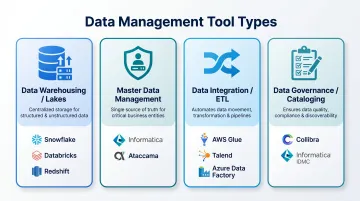
Before reviewing the list, orient yourself around the primary tool types:
- Data warehousing/lakes — store and query large volumes of structured and semi-structured data (Snowflake, Databricks, Redshift)
- Master Data Management (MDM) — create consistent, authoritative records across business systems (Informatica, Ataccama)
- Data integration/ETL — move and transform data between systems (AWS Glue, Talend, Azure Data Factory)
- Data governance/cataloging — track lineage, enforce policies, and ensure data quality and compliance (Collibra, Informatica IDMC)
11 Best Data Management Platforms & Services in 2026
Platforms were evaluated across five dimensions:
- Integration breadth — connector coverage and ecosystem compatibility
- Scalability — performance under growing data volumes and user loads
- Governance capabilities — lineage, cataloging, policy enforcement, and compliance
- AI/ML readiness — native ML tooling, AutoML, and LLM integration
- Business size fit — suitability from lean SMB teams to large enterprise deployments
Snowflake
Snowflake's architecture separates compute from storage, allowing each to scale independently — a practical advantage when query workloads spike unpredictably. It's the analytical core of many modern data stacks, sitting alongside transformation tools like dbt and ingestion tools like Fivetran.
The platform's AI layer, Snowflake Cortex, entered public preview at Summit 2025 with multimodal SQL processing, natural language querying, and AI observability. Snowflake Horizon serves as the governance and catalog hub.
| Attribute | Details |
|---|---|
| Best For | SQL-first analytics teams building a modern cloud data stack |
| Key Features | Data sharing, Snowpark (Python/Java), Cortex AI, Horizon governance catalog |
| Deployment | Cloud-native (AWS, Azure, GCP); consumption-based pricing |
Databricks
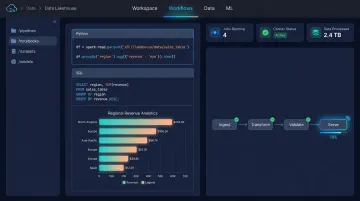
Databricks pioneered the Lakehouse architecture — combining data lake flexibility with warehouse performance via Delta Lake. It's the platform of choice for organizations running both data engineering and machine learning in the same environment.
Databricks was named a Leader in the 2025 Gartner Magic Quadrant for Cloud Database Management Systems for the fifth consecutive year, and also took the top spot in the 2025 Gartner Magic Quadrant for Data Science and Machine Learning Platforms. The Photon engine delivers up to 12x speedups over competing cloud warehouses on certain workloads.
| Attribute | Details |
|---|---|
| Best For | Organizations running ML/AI pipelines alongside data engineering; teams prioritizing open-format storage |
| Key Features | Delta Lake, Unity Catalog, MLflow, Photon SQL engine, AutoML, Model Serving |
| Deployment | Cloud-native (AWS, Azure, GCP); custom pricing |
Microsoft Fabric
Microsoft Fabric consolidates Azure Data Factory, Synapse Analytics, Power BI, and Real-Time Intelligence into a single SaaS offering. The shared OneLake storage layer (built on Delta Parquet) underpins all workloads, eliminating the need to copy data between services.
The strongest fit is for Microsoft-centric organizations — those running Azure, Office 365, or Dynamics. Copilot integration enables natural language querying for business users. Some enterprise features remain in preview as of April 2026. Pricing starts at approximately $0.18 per CU-hour (F2 SKU).
| Attribute | Details |
|---|---|
| Best For | Azure/Office 365/Dynamics environments wanting a unified ETL-to-BI platform |
| Key Features | OneLake unified storage, Data Factory pipelines, Power BI, Copilot AI, Real-Time Intelligence |
| Deployment | Cloud-native SaaS; from ~$0.18/CU-hour |
AWS Data Management Suite
AWS offers the broadest modular suite: S3 for storage, Redshift for warehousing, Glue for serverless ETL, Lake Formation for governance, Kinesis for streaming, and Athena for serverless querying. The ecosystem is vast — AWS Glue alone supports an extensive library of pre-built connectors spanning Salesforce, SAP, Google Ads, and ServiceNow.
AWS holds FedRAMP High authorization, HIPAA eligibility, and SOC 1/2/3 certifications — making it one of the strongest compliance postures available. The trade-off: the multi-service architecture demands significant engineering overhead to configure and maintain.
| Attribute | Details |
|---|---|
| Best For | AWS-native enterprises wanting fine-grained architectural control across the data stack |
| Key Features | S3, Redshift, Glue ETL, Lake Formation governance, Kinesis streaming, Athena serverless queries |
| Deployment | Cloud-native; consumption-based pricing per service |
Informatica Intelligent Data Management Cloud (IDMC)
Informatica covers more ground under one roof than almost any other vendor: MDM, data quality, cataloging, integration, lineage, and privacy — all powered by the CLAIRE AI engine for automated data discovery and mapping.
The platform has been named a Leader in the 2025 Gartner Magic Quadrant for Data Integration Tools for the 20th consecutive year, positioned furthest on the Completeness of Vision axis for 12 consecutive years. That depth comes with complexity — complex licensing and a steep learning curve make IDMC better suited for large enterprises than lean SMB teams.
| Attribute | Details |
|---|---|
| Best For | Large enterprises needing a single vendor for MDM, ETL, quality, governance, and cataloging |
| Key Features | CLAIRE AI engine, Cloud Data Governance & Catalog (CDGC), MDM with survivorship rules, data quality profiling, lineage tracking |
| Deployment | Hybrid (cloud and on-premises); custom enterprise pricing |
Collibra
Collibra focuses specifically on data governance, cataloging, lineage, and policy enforcement — and does those things exceptionally well. It's a recognized Leader in the 2025 Gartner Magic Quadrant for Data and Analytics Governance Platforms, and it's widely deployed in regulated industries where demonstrable data lineage matters to auditors.
Automated business glossary creation, end-to-end lineage tracking from source to dashboard, and policy workflow automation are standout capabilities. Implementation typically requires dedicated data governance staff and can be time-intensive to configure fully.
| Attribute | Details |
|---|---|
| Best For | Enterprises in regulated industries (finance, healthcare) requiring demonstrable data lineage and policy compliance |
| Key Features | Data catalog, data lineage, governance workflows, privacy management, data quality monitoring |
| Deployment | Cloud-native; custom enterprise pricing |
IBM InfoSphere
IBM InfoSphere is a modular enterprise suite covering MDM, ETL/ELT, data quality, profiling, and information governance. It runs on-premises and in the cloud with deep integration into the IBM ecosystem.
Long established in banking, insurance, and government for its compliance depth and multi-domain MDM capabilities. Worth noting: older versions (11.3, 11.5) have reached end-of-support, and IBM's modernization path now points toward Cloud Pak for Data. Specialized implementation expertise is required, and licensing costs are substantial.
| Attribute | Details |
|---|---|
| Best For | Large regulated enterprises with existing IBM infrastructure needing multi-domain MDM and deep compliance controls |
| Key Features | ETL/ELT pipelines, master data management, data profiling/quality, lineage, Watson-powered analysis |
| Deployment | On-premises and hybrid cloud; custom enterprise pricing |
Talend Data Fabric (Qlik Talend Cloud)
Now branded Qlik Talend Cloud following Qlik's 2023 acquisition, this platform handles batch ETL, real-time streaming, and API management in one toolset. Its open-source roots (Talend Open Studio) still appeal to data engineering teams wanting an open foundation with enterprise upgrade options.
The platform supports hundreds of connectors across enterprise applications and databases. User feedback on Gartner Peer Insights (559 reviews) notes some concerns around technical support responsiveness and performance at very high data volumes — worth factoring into procurement decisions.
| Attribute | Details |
|---|---|
| Best For | Teams wanting an open-source integration foundation with enterprise governance for batch, streaming, and API workloads |
| Key Features | Extensive connector library, data quality monitoring, low-code pipeline designer, streaming support, API management |
| Deployment | Open source and cloud; custom pricing with free trial available |
Domo
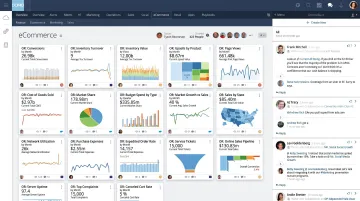
Domo combines data integration, transformation, governance, and business intelligence in a single cloud environment — designed for teams that want analytics without managing a multi-tool stack. It's been recognized as a G2 Leader for 32 consecutive quarters across BI, ETL, and data governance categories (Winter 2026).
Domo uses a credit-based consumption model rather than fixed tiers, making it flexible for SMBs with variable workloads. Prebuilt connectors and drag-and-drop ETL tools lower the barrier for non-technical users considerably compared to enterprise-grade platforms.
| Attribute | Details |
|---|---|
| Best For | SMBs and mid-market teams wanting unified data management and BI without a complex multi-tool data stack |
| Key Features | Prebuilt connectors, drag-and-drop ETL, built-in dashboards, self-service analytics, governance and lineage features |
| Deployment | Cloud-native SaaS; credit-based consumption pricing |
Ataccama ONE
Ataccama ONE combines MDM and data quality in a single platform powered by AI-driven entity matching and automated cleansing. Rather than relying on static rules, the platform learns from each resolution to improve matching accuracy over time — a meaningful advantage when working with dirty or fragmented datasets.
The platform creates golden records by consolidating duplicate and conflicting data into a single authoritative source, supported by 300+ built-in data quality functions. Ataccama is a Leader in the 2026 Gartner Magic Quadrant for Augmented Data Quality Solutions. Particularly strong for post-merger scenarios or legacy ERP migrations.
| Attribute | Details |
|---|---|
| Best For | Organizations with complex, dirty data from post-merger integrations or legacy ERP migrations |
| Key Features | AI-driven entity matching, automated data cleansing, golden record creation, lineage tracking, access controls |
| Deployment | Cloud-native; custom enterprise pricing |
nDataStor Managed Data Services
nDataStor is a Northern California managed IT services provider with 15+ years of experience serving SMBs in healthcare, legal, financial services, and technology. The firm handles cloud data solutions, proactive backup, compliance support, and strategic IT planning — with no internal IT team required on the client side.
Every client is assigned a dedicated vCIO and Technical Account Manager. They assess current infrastructure, build a custom IT roadmap, and keep technology decisions aligned with business goals. Recognized as Best IT Services in Fairfield 2025, nDataStor covers Solano, Yolo, Sacramento Counties, and San Jose.
| Attribute | Details |
|---|---|
| Best For | SMBs in Northern California (healthcare, legal, financial services) needing a local managed IT and data services partner with compliance expertise |
| Key Features | 24/7 security monitoring, cloud data solutions, proactive backup, HIPAA/PCI-DSS/CMMC compliance support, vCIO advisory, 1-hour response guarantee |
| Deployment | Fully managed on-site and remote support; flat-rate engagement model |
How We Chose the Best Data Management Platforms & Services
Platforms were assessed across six dimensions: integration breadth, scalability, governance and compliance features, AI/ML readiness, usability for non-technical teams, and total cost of ownership. A common mistake buyers make is selecting a platform based on brand recognition without matching its capabilities to their actual data complexity and team skill level.
Criteria Weighted Most Heavily
- Native connectivity — the quality and quantity of pre-built connectors directly affects how quickly a platform delivers value
- Compliance support — for healthcare, legal, and financial services organizations, HIPAA, CCPA, and SOC 2 readiness isn't optional
- Total cost of ownership — licensing fees are only part of the picture; implementation effort, ongoing engineering overhead, and training costs often exceed the platform subscription itself
- Vendor support quality — critical for teams without dedicated data engineers to troubleshoot misconfigurations
The SMB Consideration
For SMBs without dedicated data engineering resources, ease of implementation and access to expert support carry as much weight as feature depth. Gartner data shows 59% of organizations don't currently measure their data quality — meaning most SMBs are selecting platforms before establishing any baseline data management practice.
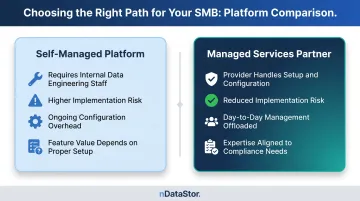
A platform with advanced features only pays off when it's properly configured and actively managed. For many SMBs, that's not a given. This is why managed services providers like nDataStor belong in this comparison — the managed approach addresses two specific gaps:
- Implementation risk — a provider handles setup and configuration that in-house teams often lack bandwidth to complete
- Ongoing overhead — day-to-day management and troubleshooting stay off the internal team's plate
Conclusion
The best data management platform isn't the most feature-rich one. It's the one that matches your team's real capabilities, your compliance obligations, and your business goals. Choosing based on analyst rankings alone — without accounting for implementation complexity or total cost of ownership — creates technical debt that compounds quickly.
That debt is avoidable. Before finalizing any decision, assess scalability, TCO beyond licensing fees, and expert support availability. Bring in your IT leadership or a managed services partner early — they'll surface the implementation risks that vendor demos won't show you.
For SMBs in Northern California that need help evaluating, implementing, or managing a data solution, nDataStor's team brings 15+ years of hands-on experience, compliance alignment across HIPAA, PCI-DSS, and CMMC frameworks, and a dedicated vCIO for every client — so business owners stay focused on growth, not infrastructure complexity. Connect with the nDataStor team to start with a consultation.
Frequently Asked Questions
Which IT services are best for data management?
Managed IT services providers handle data backup, cloud storage, compliance-aligned governance, and integration support. They're particularly valuable for SMBs in healthcare, legal, and financial services that lack in-house data engineering resources — delivering outcomes that self-managed platforms often can't without dedicated technical staff.
What is the best data management platform?
The right choice depends on data complexity, team expertise, compliance requirements, and budget. Snowflake and Microsoft Fabric lead for analytics, Informatica and Collibra for governance, and Domo or a managed services partner like nDataStor for SMBs needing lower operational overhead.
Which cloud service is best for data integration?
The leading options are AWS Glue, Azure Data Factory (embedded in Microsoft Fabric), and Qlik Talend Cloud. The best choice depends on your existing cloud infrastructure — Microsoft-centric organizations tend to favor Fabric, while AWS-native teams benefit from the broader AWS suite.
What are the top CDP platforms?
Salesforce Data Cloud and Segment (Twilio) lead for unifying customer identity and behavioral data across marketing, sales, and service touchpoints. Unlike enterprise DMPs, CDPs focus on customer-specific data activation rather than broader data infrastructure.
What is the difference between a data management platform and data management services?
Platforms are software tools that organizations configure and operate themselves. Managed data services mean a third-party provider handles implementation, monitoring, and ongoing management — a better fit for SMBs with limited internal IT support.
How do small businesses choose a data management platform?
Identify your primary use case first — analytics, compliance, integration, or MDM. Assess your internal technical capacity, evaluate total cost of ownership beyond licensing, and consider whether a managed services partner can reduce implementation risk and long-term maintenance burden.