
Introduction
Cyberattacks hit a small business every 11 seconds — and 60% of small companies that suffer a significant breach close within six months. For SMBs, choosing the wrong security partner isn't just a technology mistake; it can be a business-ending one.
The challenge is that the cybersecurity market wasn't built with small businesses in mind. Enterprise platforms like Cisco and Palo Alto Networks offer impressive capabilities, but come with complexity and price tags that overwhelm organizations without dedicated IT teams. Meanwhile, underpowered solutions leave dangerous gaps that attackers exploit quickly.
You'll find a curated breakdown of five top IT security services companies — evaluated for real-world fit, not just feature lists — along with what SMBs should prioritize when making this decision in 2025.
Key Takeaways
- 43% of all cyberattacks target small businesses, yet most remain largely unprotected
- Top providers span enterprise giants (CrowdStrike, Palo Alto Networks, Cisco) and SMB-focused options (Huntress, nDataStor)
- Key selection factors: 24/7 monitoring, guaranteed response times, ransomware defense, compliance support, and local availability
- Bigger isn't better for SMBs — personalized, managed security typically delivers more value than self-serve enterprise tools
- The right provider matches your business size, industry, and compliance requirements — not just your budget
The IT Security Landscape SMBs Are Actually Facing
Modern IT security goes well beyond antivirus software. Today's threat environment demands a layered stack:
- EDR (Endpoint Detection and Response) — continuous monitoring of devices for real-time threat detection
- MDR (Managed Detection and Response) — outsourced SOC with human analysts hunting threats 24/7
- XDR (Extended Detection and Response) — unified detection across endpoints, networks, cloud, and identity
Traditional antivirus relies on known threat signatures. That makes it ineffective against fileless attacks and zero-day exploits, which now dominate the threat landscape. CrowdStrike's 2026 Global Threat Report notes the average attacker breakout time has dropped to just 29 minutes — leaving almost no room for manual detection.
Those numbers hit smaller businesses hardest. SMBs are disproportionately targeted precisely because they hold valuable data without enterprise-grade defenses:
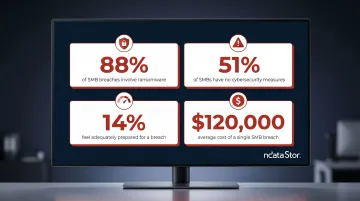
- 88% of small business breaches involve ransomware — 2.3x the rate at larger organizations
- 51% of small businesses have no cybersecurity measures in place at all
- Only 14% of SMBs consider themselves adequately prepared against cyber threats
- The average breach costs a small business approximately $120,000 per incident
For Northern California businesses, those national figures translate into a local reality. The region's density of technology firms, healthcare providers, and law firms means attackers have no shortage of high-value targets — and limited IT defenses to stop them.
Top IT Security Services Companies & Cybersecurity Providers
Companies on this list were evaluated across: threat detection depth, response speed, SMB suitability, compliance expertise, AI/automation integration, and verifiable customer trust indicators.
nDataStor
Founded in 2008 and headquartered in Fairfield, California, nDataStor is a managed IT and cybersecurity firm serving small and mid-sized businesses across Northern California — including Solano, Yolo, and Sacramento Counties, with offices in Fairfield, Sacramento, and San Jose serving Silicon Valley.
What separates nDataStor from most providers on this list is focus. Unlike the enterprise platforms on this list, nDataStor was purpose-built for SMBs. Every client gets a dedicated vCIO who builds IT roadmaps aligned to business goals, not just technology checklists. Their security stack includes AI-powered threat prevention, 24/7 monitoring, ransomware defense, dark web monitoring, and compliance support for HIPAA, PCI-DSS, and CMMC.
For regulated industries like healthcare and legal — where a breach means both financial loss and regulatory consequences — nDataStor's compliance-first approach is a meaningful differentiator. The company has served these sectors since 2008 and earned recognition as Best IT Services in Fairfield 2025.
| Best For | Small to mid-sized businesses in Northern California needing proactive, full-service cybersecurity and managed IT with local, on-site support |
| Key Features | 24/7 security monitoring, AI-powered threat prevention, ransomware defense, compliance support (HIPAA, PCI-DSS, CMMC), vCIO services, dark web monitoring, remote and on-site support |
| Pricing / Availability | Flat-rate custom pricing; 100% money-back guarantee; serving Fairfield, Sacramento, San Jose, Silicon Valley, and surrounding Northern California counties |
CrowdStrike
Founded in 2011 and headquartered in Austin, Texas, CrowdStrike built its reputation on the cloud-native Falcon platform — widely considered the gold standard for endpoint detection and response.
CrowdStrike has been named a Gartner Magic Quadrant Leader for Endpoint Protection Platforms for six consecutive years, positioned furthest right for vision and highest for execution. Its Falcon OverWatch team provides 24/7 human-led threat hunting on top of AI-driven behavioral analytics — catching sophisticated attacks that automated defenses miss.
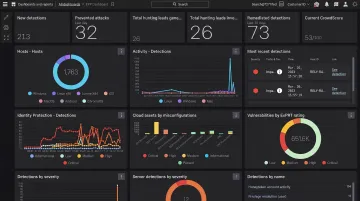
The honest caveat for SMBs: Falcon's breadth is both its strength and its limitation for smaller organizations. Without dedicated in-house security expertise, getting full value from the platform requires investment in people, not just the subscription.
| Best For | Mid-to-large enterprises requiring advanced endpoint detection, cloud-native security, and 24/7 managed threat response |
| Key Features | EDR, XDR, MDR, AI-driven behavioral analytics, threat intelligence, cloud and identity security, Falcon OverWatch human threat hunting |
| Pricing / Availability | Custom/contact sales; modular subscription tiers available |
Palo Alto Networks
Founded in 2005 and headquartered in Santa Clara, California, Palo Alto Networks serves over 70,000 organizations in 150+ countries, including 85 of the Fortune 100, with $9.22 billion in FY2025 revenue.
Its Cortex and Prisma product suites deliver unified coverage across network, endpoint, and cloud environments. The Unit 42 threat research team adds real-time intelligence and incident response depth that few vendors match — Unit 42 published a full Global Incident Response Report for 2026, reflecting the scale of their research operations.
Palo Alto was named a Leader in the inaugural 2025 Gartner Magic Quadrant for Hybrid Mesh Firewall. Like CrowdStrike, its enterprise positioning means pricing and implementation complexity typically exceed what most SMBs can absorb without a mature internal IT function.
| Best For | Enterprises and large organizations seeking comprehensive, platform-driven security across network, cloud, and endpoint environments |
| Key Features | Next-gen firewalls, endpoint protection, Prisma cloud security, Cortex XDR, AI-driven threat detection, Unit 42 threat intelligence |
| Pricing / Availability | Custom enterprise pricing; free demos available |
Huntress
Founded in 2015 by former NSA cyber operators and headquartered in Columbia, Maryland, Huntress was purpose-built for one specific problem: giving SMBs and MSPs access to the same quality of threat detection that enterprises use — without requiring a full in-house SOC.
The platform protects more than 5 million endpoints and 11 million identities worldwide. Its 24/7 AI-centric SOC is staffed by human analysts who actively hunt for attacker footholds, ransomware activity, and persistent threats that bypass traditional endpoint tools. When threats are found, analysts provide direct remediation guidance, not just automated alerts.
Huntress holds a $1.5 billion valuation following a $150 million Series D in 2024, and leads multiple G2 categories including MDR, EDR, and ITDR. For SMBs without security staff, Huntress delivers enterprise-grade threat coverage at a scale that actually fits.
| Best For | Small and mid-sized businesses and MSPs needing expert-backed managed detection and response without a full in-house security team |
| Key Features | MDR, human threat hunting, ransomware detection, Microsoft 365 protection, managed ITDR, managed SIEM, analyst-led remediation guidance |
| Pricing / Availability | Contact sales for MSP and SMB pricing; modular plans available through channel partners |

Cisco
Founded in 1984 and headquartered in San Jose, California, Cisco operates one of the most comprehensive enterprise security portfolios in the industry. Its Talos Intelligence Group — 500+ researchers analyzing roughly 550 billion security events per day — is among the largest commercial threat intelligence operations on the planet.
Cisco XDR ties together Secure Firewall, Umbrella, Duo, and Identity Services Engine into a unified detection and response architecture. For organizations already operating within the Cisco ecosystem, this integration delivers genuine visibility across complex environments. The company earned recognition in both the 2025 IDC MarketScape for Enterprise Hybrid Firewall and the Gartner Hybrid Mesh Firewall Magic Quadrant.
The trade-off: Cisco's security solutions are designed for large enterprises. SMBs without existing Cisco infrastructure would be building from scratch, facing significant costs and implementation complexity.
| Best For | Large enterprises with existing Cisco infrastructure seeking deeply integrated security across networks, cloud environments, endpoints, and identities |
| Key Features | Secure Firewall, Cisco XDR, Cisco Umbrella, Identity Services Engine, cloud security, zero-trust access, Talos threat intelligence |
| Pricing / Availability | Custom enterprise pricing via Security Enterprise Agreement; broad global partner ecosystem |
How We Chose the Best IT Security Services Companies
Brand recognition alone is a poor selection filter. A well-known enterprise platform can be the wrong choice for a 20-person law firm — both because of cost and because these tools assume a level of internal security expertise most SMBs don't have.
What Actually Matters for SMBs
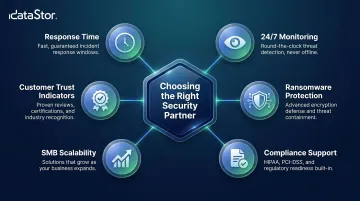
This evaluation focused on practical fit across six dimensions:
- Response time — Does the provider guarantee how fast they respond? Vague SLAs aren't acceptable when a breach is unfolding
- 24/7 monitoring — Automated alerts aren't enough; real coverage requires continuous human or AI-assisted oversight
- Ransomware and endpoint protection — Ransomware consistently tops the list of SMB threats; providers without dedicated defense for it aren't built for today's risk environment
- Compliance support — Healthcare, legal, and financial firms need providers who understand HIPAA, PCI-DSS, and CMMC — not just general IT
- SMB scalability — Can this solution grow with a 10-person team without requiring a full IT department to manage it?
- Customer trust indicators — Guarantees, verified reviews, and transparent commitments carry more weight than marketing claims
Fit Over Prestige
A Forbes Business Council analysis found that selecting a cybersecurity vendor based on brand name — without evaluating SMB-specific fit, transparency, and long-term viability — is a costly mistake. The right provider for a Silicon Valley tech startup looks very different from the right provider for a Fairfield medical practice, even if both face equally serious threats.
That gap widens when geography enters the picture. Local on-site support, familiarity with regional compliance environments, and the ability to respond to physical incidents are factors purely cloud-based or national providers can't replicate.
Conclusion
The cybersecurity market has no shortage of capable providers — the challenge is matching their strengths to your actual situation. Enterprise platforms like Cisco and Palo Alto Networks deliver extraordinary capability, but they're designed for organizations with the infrastructure and expertise to use them. For most SMBs, that's not the right starting point.
What small and mid-sized businesses need most is proactive, managed security with clear service commitments: 30-minute response times, 24/7 monitoring, compliance expertise, and a partner who understands their industry.
For SMBs across Northern California, nDataStor delivers on all of it — enterprise-grade cybersecurity, dedicated vCIO support, local on-site service, and compliance readiness for HIPAA, PCI-DSS, and CMMC, backed by a 100% money-back guarantee. Reach out to the nDataStor team to talk through what your business needs.
Frequently Asked Questions
What is the 80/20 rule in cybersecurity?
A small number of known vulnerabilities account for the majority of successful attacks. Businesses with limited IT budgets can dramatically reduce risk by focusing on actively exploited weaknesses — like those tracked in CISA's Known Exploited Vulnerabilities catalog — rather than trying to patch every CVE in existence.
What should small businesses look for in a cybersecurity provider?
Prioritize guaranteed response times, 24/7 monitoring, ransomware defense, and compliance support relevant to your industry. Also verify that the provider offers both remote and on-site support, and that their pricing is built for SMB budgets rather than enterprise contracts.
Is antivirus software enough to protect my business?
No. Antivirus catches known threats using signatures, but it's ineffective against fileless attacks, zero-day exploits, and AI-augmented intrusion methods. Businesses need a layered approach: endpoint detection, network monitoring, access controls, and incident response capabilities working together.
What is the difference between managed IT services and managed cybersecurity services?
Managed IT covers broad technology management — hardware, software, cloud, helpdesk. Managed cybersecurity focuses specifically on threat detection, vulnerability management, and incident response. Many modern MSPs, including nDataStor, integrate both under one roof so clients don't need separate vendors.
How much do IT security services typically cost for a small business?
Costs vary based on endpoints, compliance requirements, and service scope — but context matters: the average breach costs a small business roughly $120,000, which dwarfs annual managed security fees. Look for providers offering flat-rate or transparent custom pricing rather than unpredictable per-incident billing.
Which industries are most frequently targeted by cyberattacks?
Finance, manufacturing companies, and Professional Services account for more than 75% of targeted cyberattack cases according to the Verizon DBIR. Healthcare carries the highest average breach cost of any sector, making it a priority target for ransomware groups.