
Penetration testing is one of the most direct ways to find exploitable gaps before attackers do. But the provider you choose matters just as much as the test itself — the wrong firm can hand you a glorified vulnerability scan dressed up as a pen test.
This article covers 13 leading U.S. penetration testing companies, the criteria used to evaluate them, and practical guidance for matching a provider to your actual risk environment and budget.
Key Takeaways
- Penetration testing actively exploits vulnerabilities using human testers, making it fundamentally different from automated scanning.
- The right provider depends on your environment, budget, and security maturity: boutique manual specialists, enterprise platforms, and PTaaS models each serve different needs.
- Pricing in the USA typically ranges from $5,000 for a basic external test to $100,000+ for advanced red team engagements.
- Prioritize providers with senior testers, a strong manual-to-automated ratio, and reports that explain business risk beyond CVSS scores.
- A pen test is a point-in-time snapshot; pair findings with ongoing managed security to maintain the ground you gain.
What Is Penetration Testing and Why Does It Matter for U.S. Businesses?
Penetration testing is a controlled, authorized simulation of a cyberattack. Ethical hackers actively attempt to exploit weaknesses across networks, applications, cloud environments, and systems — then document exactly how far they got and what business impact that exposure could have.
This is categorically different from vulnerability scanning. Scanning uses automated tools to flag potential weaknesses, but it produces high false-positive rates and never confirms whether a flaw is actually exploitable. NIST SP 800-115 makes this distinction explicit: pen testing "mimics real-world attacks to identify ways to circumvent security features," while scanning only identifies surface-level issues.
Why U.S. Businesses Can't Afford to Skip It
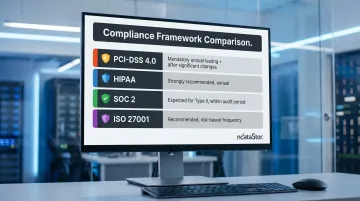
Regulatory pressure is accelerating this shift. Several major compliance frameworks now treat pen testing as a requirement or strong expectation:
| Framework | Pen Testing Requirement | Frequency |
|---|---|---|
| PCI-DSS 4.0 | Mandatory (Req. 11.4), effective March 2025 | Annual + after significant changes |
| HIPAA | Strongly recommended as part of risk assessment | Annual |
| SOC 2 | Expected for Type II audits | Within audit period |
| ISO 27001 | Recommended under Annex A controls | Based on risk assessment |
Healthcare organizations, finance, legal, and technology companies across Northern California face all of these frameworks simultaneously — making pen testing both a strategic investment and a compliance necessity.
13 Best Penetration Testing Companies in the USA
These companies were evaluated on testing methodology, manual testing depth, reporting quality, industry specialization, and client fit — not just brand recognition or revenue.
Redbot Security
A U.S.-based boutique firm built around senior-led, manual-first assessments. Redbot covers web applications, APIs, cloud infrastructure, networks, AI/LLM systems, and OT/SCADA environments. Testers chain vulnerabilities together to show actual attack paths — not just lists of findings. Clients get direct access to senior testers throughout, with scoping customized to their specific risk environment.
| Category | Details |
|---|---|
| Key Testing Services | Web/API, cloud, network, red team, AI/LLM, OT/SCADA |
| Best Suited For | SaaS companies, fintech platforms, and organizations needing deep manual validation |
| Pricing | Custom; contact for a scope-based quote |
Rapid7
Creator of the Metasploit penetration testing framework and one of the most recognized names in enterprise security. Rapid7 states that 85% of its testing is performed manually and its team conducts over 1,000 pen tests annually. Services span network, web, mobile, wireless, social engineering, and red team engagements.
Their storyboarded reports illustrate the full attack chain with risk comparisons — useful for both technical teams and executive leadership needing to understand exposure in business terms.
| Category | Details |
|---|---|
| Key Testing Services | Network, web, mobile, social engineering, red team, IoT |
| Best Suited For | Enterprises wanting attacker-intelligence-driven testing and detailed remediation scorecards |
| Pricing | Custom; contact Rapid7 sales |
Mandiant (Google)
Acquired by Google for $5.4 billion in 2022, Mandiant brings frontline incident response experience directly into its penetration testing engagements. Red team assessments use TTPs drawn from actual threat actor investigations — including documented emulation of groups like FIN11 for ransomware campaign simulation.
Social engineering and physical intrusion testing are available, and Mandiant can scale complex assessments across large enterprise environments with multiple business units.
| Category | Details |
|---|---|
| Key Testing Services | Adversary emulation, red teaming, network and application testing, social engineering |
| Best Suited For | Large enterprises and mature security programs needing highly realistic attack simulations |
| Pricing | Custom; contact Mandiant/Google Cloud sales |
Secureworks
Now owned by Sophos following a $859 million acquisition completed in February 2025, Secureworks leverages its Counter Threat Unit (CTU) intelligence to inform both standard and advanced penetration tests. Their adversary emulation exercises replicate APT and nation-state attacker behaviors, and reporting is structured for both technical teams and executive leadership.
| Category | Details |
|---|---|
| Key Testing Services | Network penetration testing, red teaming, application testing, managed security integration |
| Best Suited For | Organizations wanting threat-intelligence-informed testing with executive-ready reporting |
| Pricing | Custom; contact Secureworks sales |
CrowdStrike
Known primarily for its Falcon endpoint protection platform, CrowdStrike Services also offers adversary emulation and cloud security testing that simulates TTPs used by sophisticated real-world threat actors. For organizations already running Falcon, testing insights can integrate directly with the broader platform for faster remediation workflows.
| Category | Details |
|---|---|
| Key Testing Services | Adversary emulation, cloud security testing, red team exercises, external network assessments |
| Best Suited For | Organizations heavily invested in cloud infrastructure or existing CrowdStrike environments |
| Pricing | Custom; contact CrowdStrike sales |
NetSPI
Headquartered in Minneapolis, NetSPI combines deep manual testing with a proprietary PTaaS platform that delivers real-time reporting and centralized remediation tracking. The firm claims to serve 9 of the top 10 U.S. banks and employs 350+ penetration testers. Their model works particularly well for enterprises that need recurring, scalable testing alongside individual high-quality assessments.
| Category | Details |
|---|---|
| Key Testing Services | Web, API, mobile, cloud, network, red team, breach and attack simulation |
| Best Suited For | Large enterprises needing scalable PTaaS with platform dashboards and recurring testing |
| Pricing | Custom; contact NetSPI for a tailored quote |
Cobalt
A PTaaS platform connecting organizations with a vetted global community of pentesters (the "Cobalt Core") through a credit-based model. Real-time communication, issue tracking, and customizable scoping happen inside the platform. A "Fast Start" option can get testing underway in as little as 24 hours — making it accessible for agile teams with limited procurement cycles.
| Category | Details |
|---|---|
| Key Testing Services | Web, API, mobile, network, and cloud security testing via community platform |
| Best Suited For | Agile teams and growth-stage companies needing flexible, fast-to-launch pen testing |
| Pricing | Fast Start from approximately $5,000; broader programs custom priced |
BreachLock
A hybrid PTaaS provider that combines automated scanning for coverage with OSCP and CREST-certified human testers who validate all findings, eliminating false positives before delivery. A SaaS client portal provides real-time access to findings, and compliance-focused packages are available for PCI DSS, HIPAA, and SOC 2 programs.
| Category | Details |
|---|---|
| Key Testing Services | Web, API, mobile, network, cloud, and compliance-aligned testing |
| Best Suited For | Companies needing scalable, compliance-ready pentesting at an accessible price point |
| Pricing | Contact BreachLock for current package pricing |
Bishop Fox
An offensive security firm based in Tempe, Arizona (Phoenix metro area) with a strong focus on red teaming, advanced application security, and cloud-native environments. Bishop Fox has conducted over 10,000 application assessments and supports formal vendor security testing including CASA and MASA compliance certifications. Their published vulnerability research demonstrates active engagement with real-world attack techniques.
| Category | Details |
|---|---|
| Key Testing Services | Red teaming, web and mobile app testing, cloud security, vendor assessments |
| Best Suited For | Enterprises and cloud-native companies needing advanced offensive security programs |
| Pricing | Custom; contact Bishop Fox for a quote |
Offensive Security (OffSec)
OffSec created the OSCP certification and Kali Linux — foundational tools in modern penetration testing. Their boutique testing arm accepts roughly 10 clients per year, with a minimum two-week engagement and an average of four weeks per test.
Testers are the same team behind Kali Linux and Exploit-DB. Engagements are limited by design; this firm suits organizations prioritizing depth and rigor over speed or volume.
| Category | Details |
|---|---|
| Key Testing Services | Manual network and application penetration testing, advanced adversary simulation |
| Best Suited For | Organizations seeking elite, high-depth testing — roughly 10 clients accepted per year |
| Pricing | Custom; limited availability — contact OffSec sales |
NCC Group
A globally recognized cybersecurity firm with offices across North America and Europe, NCC Group delivers penetration testing across applications, networks, hardware/IoT, cloud, and red teaming for enterprise and government clients. Their strength is scale and global delivery for complex, multi-region programs — particularly well-suited to regulated industries that need consistent coverage across geographies.
| Category | Details |
|---|---|
| Key Testing Services | Application, network, cloud, hardware/IoT, red teaming, managed detection and response |
| Best Suited For | Large enterprises, government organizations, and regulated industries needing global scale |
| Pricing | Custom; contact NCC Group for a tailored quote |
Astra Security
A PTaaS platform built around continuous testing subscriptions, Astra combines automated scanning with manual expert validation and compliance-aligned reporting for SOC 2, ISO 27001, HIPAA, and PCI-DSS. A client dashboard tracks remediation progress in real time. Pricing starts at $199/month on annual plans, making it one of the more accessible options for growing SaaS companies.
| Category | Details |
|---|---|
| Key Testing Services | Web, API, cloud, network testing with continuous subscription option |
| Best Suited For | Growing businesses and SaaS companies needing affordable continuous testing and compliance reporting |
| Pricing | Starts at $199/month (annual billing); contact Astra for enterprise pricing |
Intruder
Intruder's "Vanguard" plan pairs continuous automated scanning (powered by Tenable Nessus) with manual expert validation — security analysts chain vulnerabilities, investigate false positives, and conduct impact reviews rather than just flagging issues. Cloud configuration assessments for AWS, Azure, and Google Cloud, plus OWASP-guided API testing, make Intruder particularly useful for organizations with significant API exposure or complex cloud environments.
| Category | Details |
|---|---|
| Key Testing Services | API testing, cloud config assessments, external infrastructure, continuous vulnerability monitoring |
| Best Suited For | Cloud-heavy organizations and API-driven businesses needing continuous exposure management |
| Pricing | Contact Intruder for penetration testing pricing |
How to Choose the Right Penetration Testing Partner
Not every pen testing provider is interchangeable. Here's how to narrow the field before you sign anything.
Match the Provider Type to Your Needs
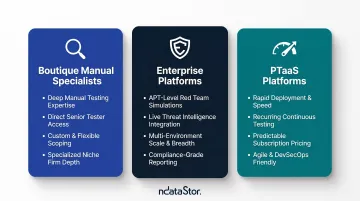
Three distinct categories serve different buyers:
- Boutique manual specialists (Redbot Security, OffSec): Best for organizations that need depth, direct tester access, and customized scoping — often the right choice for compliance-driven tests or environments with complex custom applications
- Enterprise platforms (Mandiant, CrowdStrike, NCC Group, Secureworks): Best for large organizations with complex multi-environment programs, APT-level threat exposure, or the need for threat-intelligence-driven attack simulations
- PTaaS platforms (Cobalt, Astra, BreachLock, Intruder): Best for growth-stage companies, agile teams, or businesses needing recurring testing at a predictable cost
Evaluate Reporting Quality Before You Commit
A pen test report should tell you:
- Enough technical detail on each finding to reproduce and fix it
- The actual attack path used — not just a CVSS score
- Business risk impact written for executives, not only engineers
- Remediation steps ranked by risk severity, not alphabetically
Ask every shortlisted vendor for a sample report. If they won't share one, that's a red flag.
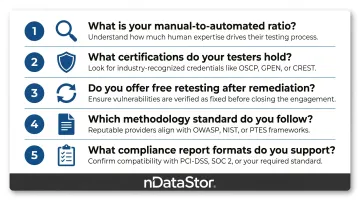
Key Questions to Ask Any Provider
- What is your manual-to-automated testing ratio?
- What certifications do your testers hold (OSCP, GPEN, CREST)?
- Does retesting after remediation come with the engagement?
- What methodology standard do you follow — OWASP, NIST SP 800-115, PTES?
- What does your report look like for a PCI-DSS or SOC 2 audit?
The Gap a Pen Test Can't Fill
Penetration testing is a point-in-time assessment. Once the report is delivered, your environment continues to change — new users, new configurations, new threats. For Northern California SMBs navigating this gap, nDataStor offers managed security services — continuous monitoring, threat prevention, and compliance support for HIPAA, PCI-DSS, and CMMC — that keep the findings from a pen test working year-round rather than sitting in a report. This is especially relevant for law firms and other professional services businesses handling sensitive client data.
Conclusion
Choosing the right penetration testing company comes down to methodology, tester expertise, and reporting quality — specifically how well they align with your risk environment and compliance requirements. Brand name and price are secondary.
Before finalizing any engagement, cover these four checkpoints:
- Request a sample report to evaluate depth and clarity
- Confirm the manual-to-automated testing ratio
- Verify tester credentials (OSCP, CEH, or equivalent)
- Clarify whether retesting after remediation is included
The resulting report is the starting point of your security program, not the finish line.
For businesses in Northern California looking to build ongoing security around their pen test findings, nDataStor provides managed security services — including 24/7 monitoring, ransomware defense, and compliance support — with a 30-minute response guarantee and a 100% money-back guarantee. Reach out for a consultation to discuss how continuous protection fits alongside your testing program.
Frequently Asked Questions
How much should a pen test cost?
Most penetration tests in the USA range from $5,000–$20,000 for external network or web application tests, $10,000–$50,000 for comprehensive multi-scope assessments, and $100,000+ for advanced red team engagements. Scope, environment complexity, and the manual testing depth are the primary cost drivers.
What are the top pen testing companies?
Commonly evaluated providers include Redbot Security, Rapid7, Mandiant, NetSPI, Cobalt, and Bishop Fox — but "top" depends entirely on your situation. Manual-first boutiques suit different buyers than enterprise threat-intelligence platforms or PTaaS models built for speed and scalability.
What is the difference between penetration testing and vulnerability scanning?
Vulnerability scanning uses automated tools to flag known weaknesses without confirming exploitability. Penetration testing involves human testers who actively exploit vulnerabilities, chain findings together, and demonstrate real business impact — which is why compliance frameworks like PCI-DSS, SOC 2, and HIPAA specifically expect pen testing, not just scanning.
How often should a business get a penetration test?
Most compliance frameworks require at least annual testing, with additional tests warranted after major infrastructure changes, application launches, cloud migrations, or acquisitions. Organizations handling payment card or healthcare data should consider quarterly or continuous testing models.
Do small businesses need penetration testing?
Yes. Small businesses are frequently targeted because attackers assume weaker defenses. 88% of small business breaches in 2025 involved ransomware, making proactive testing a practical necessity, not a luxury. Several providers on this list — including Cobalt, Astra, and BreachLock — offer accessible price points and SMB-appropriate packages.
How long does a penetration test take?
Most engagements run one to three weeks from kickoff to final report delivery — a focused web application test typically wraps in five to seven business days, while larger multi-environment assessments or red team exercises take two to four weeks.