Written by
Peter Prieto, Cybersecurity Expert
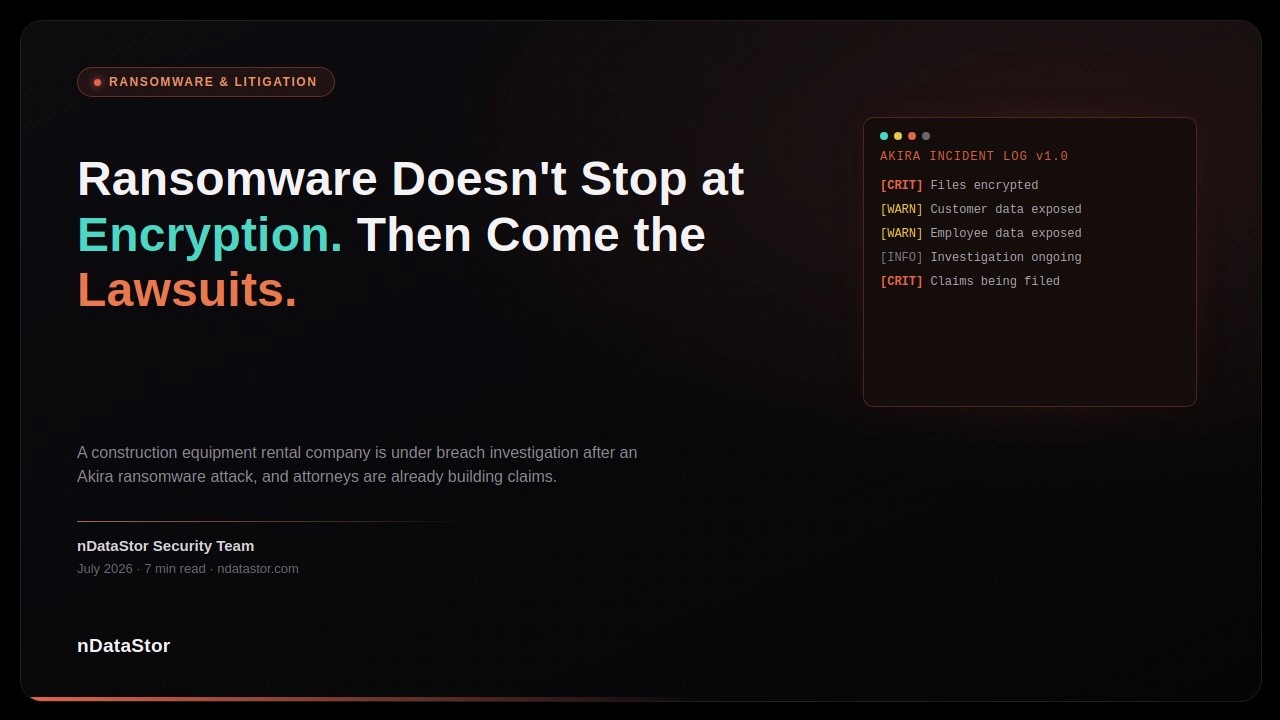
A construction equipment rental company is under breach investigation after an Akira ransomware attack. Attorneys are reportedly building potential claims on behalf of Vandalia Rental customers and employees following the July 2026 incident, according to ClassAction.org.
The ransomware attack itself is only the first chapter. What follows it, an investigation, potential litigation, claims on behalf of both customers and employees, is the part that tends to stretch out far longer than the initial incident, and cost far more than most businesses plan for.
Why This Hits Close to Home for Construction and Equipment Rental Businesses
Equipment rental companies are not the businesses that typically come to mind when people picture ransomware targets, and that is exactly the point. These are operationally intensive businesses, running scheduling systems, payment processing, customer accounts, and often employee data across a mix of legacy software and newer cloud tools, frequently with a smaller dedicated IT and security function than the value of the data would suggest.
That combination, valuable operational and customer data, combined with security resourcing that has not always kept pace with the business's growth, is exactly what makes construction-adjacent businesses an attractive target. Akira, the ransomware group named in this incident, has built a track record of targeting mid-sized businesses across a range of industries, not just the largest enterprises with the deepest pockets.
What "Under Investigation" Actually Means
When a breach moves into the investigation and litigation phase, it stops being purely a technical problem and becomes an operational one that touches nearly every part of the business. Customers whose data was exposed need to be notified. Employees whose information was compromised need answers too, and in cases like this one, may become claimants themselves. Legal counsel gets involved early and stays involved for a long time. None of that is quick, and none of it is inexpensive, regardless of how the ransomware itself ultimately gets resolved.
This is the stage most businesses underestimate when they think about ransomware risk. The ransom demand, if there is one, and the technical recovery get most of the attention. The months or years of investigation, notification, and potential legal claims that follow are where a large share of the real cost and disruption actually lives.
What This Means for Your Business
If your business handles customer or employee data on shared systems, know what your ransomware response actually covers. A response plan that stops at "restore from backup" is not a complete plan. It needs to account for notification obligations, legal exposure, and communication with the people whose data was affected.
Review your backup and recovery process specifically against a ransomware scenario, not just general data loss. Ransomware often targets backups directly. Confirm yours are isolated in a way that a successful attack on your main systems cannot also reach.
Do not assume your industry is too unglamorous to be a target. Equipment rental, construction, and similar operationally focused businesses hold exactly the kind of customer and employee data that makes a ransomware group's cost benefit calculation work in their favor.
Talk to your legal counsel and insurance provider about what a real incident response actually looks like, before you need to find out during one. Knowing who to call and what your policy actually covers is something you want settled well before an active incident.
The Bigger Picture
This is a useful, concrete example for any business that has assumed ransomware happens to somebody else, usually somebody bigger, or in a more obviously high-value industry. Construction and equipment rental businesses are exactly the kind of mid-sized, operationally critical companies that ransomware groups like Akira have been targeting. The businesses that take this seriously now are reviewing their backup strategy, their incident response plan, and their legal and insurance relationships before an attack forces the question, not after.
Stay inside the line.